Never in her 13 years of teaching . . .
Teachers are amazed at how rapidly Barton students improve — even when they are tutored by a parent, as this mother shared:
Thank you so much for developing this program and your great informational videos and website. Without those, I don’t think my daughter would have been diagnosed and gotten the help she needed.
I am currently working on Level 3 with my daughter. Since starting the Barton System, she has shown tremendous progress! Her teacher told us that in her 13 years of teaching experience, she has never seen a student have this much growth in one year! She credits the program and my commitment to it.
That teacher has been wonderful. She has allowed me to come into the classroom for an hour twice a week to do Barton with my daughter.
By the way, that teacher is now interested in using the Barton System with a few other students she thinks will benefit from it. So that is super exciting!
Jennifer Veras, parent
Modesto, CA

A Third Grade Teacher’s Point of View
By Sally Miles
Shared with prior written permission
As a teacher, dyslexia therapist (ALTA), mother and grandmother of two brilliant dyslexics, and someone who loves learning, I do my best every day to meet the needs of my students in my 3rd grade class. I fail every day, but we forgive and move on.

I do my best to address teaching in an Orton-Gillingham based manner for every subject. Not every student I have is dyslexic, but every child can benefit.
My students have so many needs that even though I truly put forth the effort, my brain and my heart cannot possibly think of everything that every child needs during every moment of every day. Among the children I greet every morning are those diagnosed and undiagnosed dyslexic children, a hearing impaired child with cerebral palsy, diagnosed and undiagnosed children with ADHD, auditory processing disorders, language disorders and autism, English as a second language, children who go to bed unfed since they left school, children who are abused, and children who are neglected.
Even though I try to meet every single need of your child, I’m going to fail. So before you call me out on Facebook, talk to me! Tell me, in a kind way, what your child needs that I am not doing.
Remember, the things your child needs that I’m trying to do . . . may be met with resistance by other parents because I teach in a way that is different, or their child may have very different needs.
Remember that I am human and may forget simply because I have so many different needs swirling through my head.
Remember that my goal is to teach all of your children, every day, with the “right” way for your child, and I will fail. I will get up again the next day and try to do better.
But it is easier if you tell me what your child needs . . . rather than think I’m too ignorant, I don’t care, I’m lazy, or I’m just another part of an often-broken system.
The importance of early intervention
If you have ever watched one of your own children struggle for years in school due to undetected dyslexia, you will step in faster when your next child starts to struggle – as this parent did.
Our story is so similar to other families I have met: the daily homework struggles, tears of frustration over a worksheet that takes other kids only a few minutes to complete, “wait and see” advice from some teachers, and “your daughter is too smart to be dyslexic” from others. I have never felt so helpless.
But when Lillian was in second grade, we were so lucky to have a teacher who pulled me aside and recommended we go outside of the school system to get a private evaluation, and lucky that the evaluator recommended the Barton Reading & Spelling System.
When we started the Barton System, Lillian was in the spring of second grade, reading at a beginning first grade level. We worked very hard to close the gap, tutoring 30 minutes every day (and increased it to an hour a day during the summer).
When Lillian took her state reading test in the spring of third grade, she scored in the “meets grade level” category – only 4 points away from “exceeds.”
Now, after her second year of tutoring, she is able to read books at her interest level, and we often catch her reading just for fun – which means more to us than any test result. The growth we have seen in her confidence and self-esteem is priceless.
I have also benefited from your program. It is so empowering to finally be able to understand how to help my kids learn to read, and to speak knowledgeably with their teachers.
But more importantly, I was able to avoid struggle and failure with my younger son Nate, who was 5 1/2 when we had his sister evaluated. Nate had almost every early warning sign for dyslexia. So I started working with him at that time (in shorter sessions), and he has learned to read solely through the Barton System. We had him privately evaluated at the beginning of his first grade year, and Nate was reading at a mid-second grade level!
Nate is a poster-child for the importance of early intervention. I recently spoke about my experience tutoring my own kids when I testified before the Oregon Senate Committee on Education in support of our dyslexia bill.
Thank you again for creating such an accessible, affordable program, and for being so helpful and available when I had questions. My kids now have a limitless future, and your program allowed me to give it to them. We are so incredibly grateful.
Theresa Sorensen
Happy Valley, OR
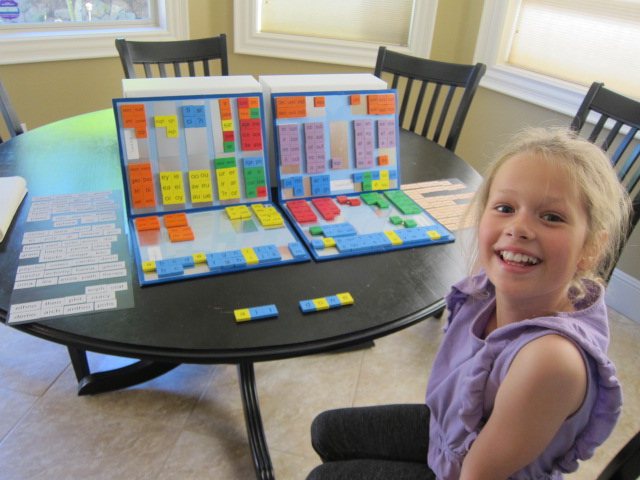
Homeschooling takes a lot of courage
It takes a lot of courage to pull your child out of public school and start homeschooling. And it requires a lot of work. But most parents of children with dyslexia will tell you that homeschooling was the best thing they ever did.
This homeschool parent’s story is so typical.
Susan, I just have to share what that my son’s (homeschool) teacher posted today. We are on Level 4 of the Barton Reading & Spelling System. He is in 4th grade.
Last year, in public school, he hit the “brick wall” and cried every day. He hated school. He hated the fact that his little sister could read better than he could. His self-esteem was nonexistent. The school refused to do ANYTHING even though we had a diagnosis of dyslexia.
So this year, in an effort to salvage whatever self-worth he had left, we decided to homeschool.
Today, I received this email from his homeschool teacher. THIS is what happens when you use EVIDENCE BASED methods that are proven to work with a dyslexic child!
Subject: Music to my ears
My son: I’m going to have to read all the way home because I want to know what is going to happen next. Can I just read it now?
Teacher: No, that’s homework.
My son: But I want to know now.
This is coming from a boy who has NEVER enjoyed reading in his life because of dyslexia and the use of ineffective reading methods in the past. Now he can’t put his book down. Proud teacher moment!
Susan, thank you for everything you do to help our kids, and to educate us and guide us in advocating for them along this rocky journey. You are an angel to many.
Cindi Bighinati
Homeschool parent in CT

Support Our Dyslexia Bill
Andrew has profound dyslexia.
He first wrote his letter of support for California’s dyslexia bill, AB1369, by hand. Then he dictated it into the computer.
Not only is his letter touching, but it proves why technology tools are just as important as tutoring. Here is his dictated letter.
Dear Assembly Member Shannon Grove,
Hi! This is Andrew and I have Dyslexia and Dysgraphia and I am in 5th grade. I am 11 years old.
Dyslexia is a one in five have it. Dyslexia makes it really hard for kids to read and write very well. Dyslexia is not recognized in the public schools and kids are feeling stupid and not very smart or happy.
I know how they feel because I am going through it now. My mom and dad took me to a therapist who said I have dyslexia and dysgraphia. Dyslexia happens in families. My uncle and dad never knew that they had it.
There are times in life when I feel I’m not the smartest kid in my class because I can’t read like the other kids. It is like, I am two grades behind. Sometimes I give up and cry but my family, teachers, and Barton tutor help me keep going.
Mrs. Grove, you can help kids like me learn to read and write by voting yes on AB1369. AB1369 can give kids like me in California the chance to do great things in their classrooms and in life.
Please vote yes on AB1369. We need your help to make this happen!
From
Andrew
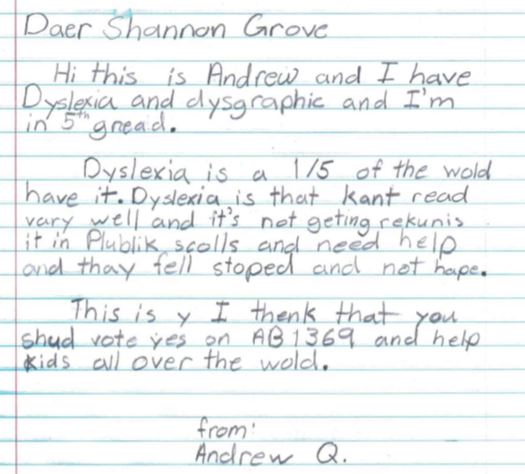
The photo in this article is his handwritten version.
Slow and steady wins the race
Slow and steady wins the race — and school testing proves it.
I love getting success stories from Barton tutors — like this one.
One of my students did not talk until he was 4 years old, had speech therapy for years starting in preschool, had been in special education since Kindergarten, and was even retained once.
When I met him at the end of 8th grade, the special education teachers had just told his parents that they had tried all they could, but he was still unable to read even the most decodable first grade words.
This student is probably my most severely dyslexic student, but also the most motivated. He has worked SO hard and has even driven to my house for a lesson when school has been cancelled due to snow.
We have made slow but steady progress.
He is a senior in high school now and just finished Level 8.
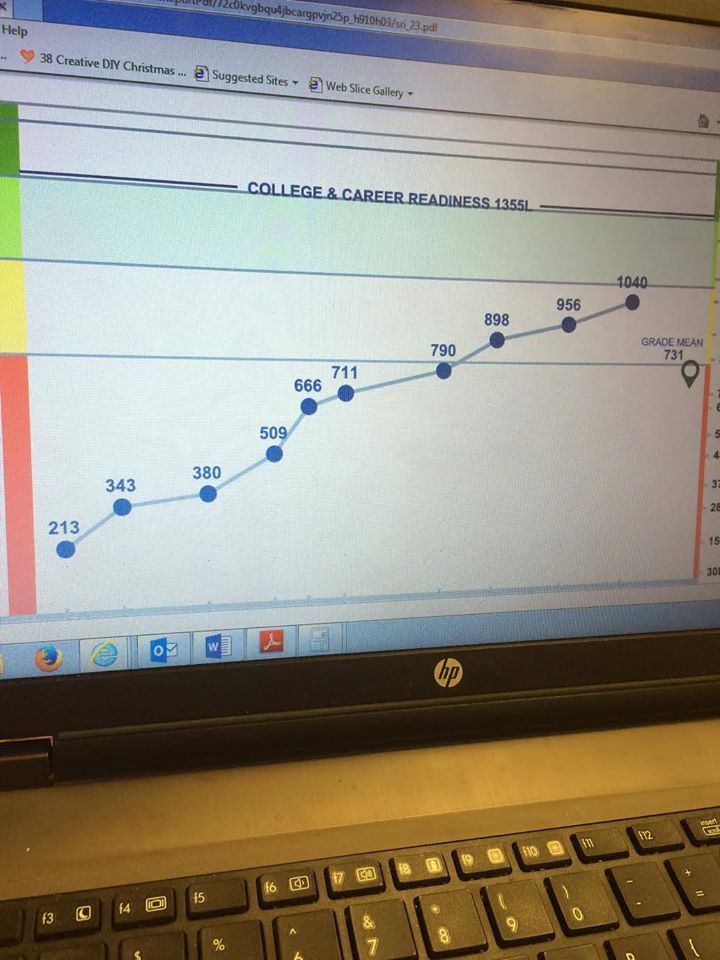
I got a text from him today that included a picture he had taken of his computer screen at school (see above) showing a graph of his progress on a school reading test – which is used to determine if a reading class is needed or not. Students need 1000 points in order to get out of the reading class and be freed up to take an elective.
His first score, 213, was from September 9, 2013. His last score, 1040, is from today, March 17, 2015.
I am just so proud of him and had to share the good news!
Karin Merkle
Certified Barton Tutor at the Advanced Level
Rapid City Dyslexia Care
Rapid City, SD
I would like to be out of a job
A dyslexia specialist wrote this powerful letter in support of California’s Dyslexia Bill, AB 1369.
Dear Assemblyman Levine,
I am a mother of two (ages 7 & 10), and a resident of Nxxxx, California. I am also a former classroom teacher, Dyslexia Specialist, free consultant, and private tutor.
As I sit to write this letter, you are in Sacramento listening to stories being told from some faces of Dyslexia.
I wish I could have been there in person today, but I was at work, tutoring an 8 year-old boy who happened to be born with a Dyslexic brain. He is struggling to read, write and spell. My job is to remediate him. My job is to educate his teachers on how to help him. My job is to calm and reassure his family that everything will be okay. My job is to build this little boy’s self-esteem back up again so he can believe that he is smart, talented and able.
I am writing to you because I would like to be out of a job.
Years ago, when I was first teaching third grade, I began to notice patterns within a few children in my class. It happened every year, class after class, without fail. There were about 3 or 4 of them who could not read, write or spell – no matter what we tried. I sat in endless SST and IEP meetings, alongside a team of caring parents, administrators, specialists and teaching professionals – as we all brainstormed, time and time again, how to best reach these children so they could “catch up” and learn like the rest of the class.
I made the grave mistake of bringing up “The D Word” in front of my principal and resource specialist one day. They both whipped around and my principal sternly warned me, “Erin, it’s a good thing you didn’t say that in front of the parents! Don’t EVER say that word again. We could be liable for that. The district could be liable.”
Then the special education director schooled me, “Yes, he’s right. And besides, Dyslexia doesn’t even exist. It’s just a broad term that was brought out in the 70’s, but there isn’t actually a learning disability called ‘Dyslexia.’”
Believe me—I got the message loud and clear and never said that word again… until I left the classroom and went out on my own. And now I am one of thousands of teachers standing before you announcing, “Dyslexia does exist.”
I have been studying Dyslexia since 2006. In 2009, I took a graduate course entitled, “Screening for Dyslexia.” It was through the University of San Diego, taught by my mentor, Susan Barton. I have learned a great deal about Dyslexia in the past nine years. But what I have learned the most is not from what I’ve seen in lectures or conferences. I do not attribute it to reading countless books and articles. I did not hear it from the mouths of doctors and scientific researchers. I did not watch it in documentaries.
I have seen it in the hundreds of fearful eyes into which I’ve looked. I have heard it within the frantic voices of parents who call me on the phone. I have experienced it sitting in tear-filled, angry IEP meetings. I have felt it in the thankful hugs families give me after I have helped them.
What I have learned the most in the past decade is that there is a monumental need for professional, educational support in the field of Dyslexia. We need to do something to help these people so they will have an equal opportunity to learn like the rest of us.
I do not have Dyslexia. My children do not have it either. But thousands of Californians are being affected by this learning difference. They are desperate. They are angry. They are frustrated and sad. They feel ignored and alone. And I believe that every single one of them is justified in their thinking. We must help them. You must help them.
Please make it mandatory that teaching credential programs include education on Dyslexia. Please give current classroom teachers training on Dyslexia. Please screen children early so we can detect Dyslexia and give them the appropriate education they deserve.
Please pass AB 1369 so I do not have to continue crusading and working with Dyslexics by myself. These children need an army of people around them for support. I am but one person. We need help. I need help.
Sincerely,
Erin Farber
CA Credentialed Teacher, Multiple Subject
Dyslexia Specialist, Consultant, Tutor

I married two of them
Wives know how talented their dyslexic husbands are – as well as how often their dyslexia has held them back in their careers, as this wife shares:
After attending your presentation, I am sure my ex-husband is dyslexic. He is an exceptionally good mechanic and handyman, gardener, and farmer. And he has the ability to visualize things that I cannot. But he also did very poorly in school.
When I shared parts of your presentation with my current husband (yes, I married another dyslexic), he opened up and shared more about his struggles. He is a classic example of the adult who did not advance in his career because of his dyslexia.
He is a social worker. He abbreviates his clinical notes so that he does not have to use big words that he cannot spell.
He never learned to keyboard, so he uses the “hunt and peck” method, which greatly slows him down.
He has to re-read technical reports numerous times to comprehend them. He cannot sound out unknown words.
Yet he has superb people skills. He has been Employee Of The Year more than once, and he is highly respected.
He would make an excellent supervisor, but he refuses to apply for that position because of his reading, spelling, and writing difficulties.
He tries to hide his difficulties. He never offers to read Scripture in our Sunday School class, and he tries to avoid being called on.
He constantly mispronounces multi-syllable words.
He appreciates that I am patient when he asks how to spell a word he must write on a check when paying the bills, or when he asks for help when he tries to read the newspaper.

Trying to make a difference
Special Ed teachers are so frustrated with the school system that they often leave and become private tutors, as this one shared in a recent email:
Susan, I have a real passion for the students who don’t catch on to reading and spelling when taught using regular curriculum.
In fact, that’s why I switched from being a regular ed teacher to a special ed teacher. I attended several Orton-Gillingham workshops and seminars, and I bought the first few Barton levels with my own money to use with my LD students.
For the past 2 years, I taught Barton as best I could within the special ed system – and got some fabulous results. My principal was amazed at the increased reading levels of my students.
But with all the “red tape” and political stuff we have to deal with, the special ed system does not allow me to do what I am I really passionate about: meeting each student’s individualized needs.
I am not allowed to spend enough time, with the correct resources, in a small enough group to help my students become the best they can be.
Sadly, I know I cannot change the special ed system. So I have decided to leave and start offering one-on-one Barton tutoring.
I know not every parent will be able to afford to hire me. But I would rather serve a few children well, so they reach their potential, then continue to serve many students poorly.
Wish me luck. This is a big leap of faith, and quite a change for me. But it’s the only way I can do what I’m passionate about: helping these bright kids the right way.

Not eligible for special education
Many children with dyslexia will not be eligible for special education services – not even if a parent brings in a diagnostic report.
In that case, fight hard for classroom accommodations – and get the right type of help after school.
This parent did not do that – and regrets it.
Dyslexia runs in my family tree. My father, who is 60, can still remember being in second grade and having the teacher call him up to the front of the class to read out loud. The teacher would force him to stand there and “do it until you get it right” – despite him crying in front of the entire class.
I have a degree in Elementary Education, but we never had a single solitary course – not even a single lecture – on dyslexia.
Yet when my daughter struggled in kindergarten, her teacher suggested the possibility of dyslexia because:
- On DIBELS, she was not meeting benchmarks in nonsense word reading
- She had terrible spelling and could not retain her spelling words — not even the high frequency words like “some”
- She already had 2 years of speech therapy for R’s and L’s, but was not improving
- She constantly confused left and right
- And she still could not tie her shoes
At end of first grade, I asked the school to test her for a possible learning disability. The school said they wouldn’t test her until at least 3rd grade.
So during second grade, when she was not making progress in Tier 2 of RTI, I hired a highly qualified private professional to test her. She was diagnosed with moderate-to-severe dyslexia.
But when I shared that report with the school psychologist, he stated that dyslexia does not exist, that Susan Barton’s website was not a valid resource, and we could not even get a 504 Plan because he felt our daughter did not need it. He claimed she displayed no difficulties and would prove to be a good student.
Her teachers and even the principal were at that meeting, and they went along with the psychologist’s assessment – leaving us to wonder if we really knew what we were talking about.
We were so confused that we decided to follow the school’s advice — and regret it.
Our daughter is now at the end of third grade. Despite another year of phonics instruction and more RTI, she still struggles with spelling, sounding out longer words, and cannot comprehend her science textbook when she reads it herself. (But she has no trouble comprehending it when I read it TO her.)
The school did eventually test her, but her scores were not low enough to qualify for Special Ed services. And her report card grades are not too bad. She gets low B’s or C’s.
We have shown our daughter’s diagnostic report to other dyslexia professionals and organizations, and they have all agreed that she definitely does have dyslexia.
So what do I do now?


 Bright Solutions for Dyslexia