We Did It
Susan Barton loves hearing from homeschool parents who have completed the Barton System — and the difference that has made in their child’s skills.
We did it! My son has successfully completed the Barton Reading and Spelling System.
We began homeschooling shortly after I started Barton with him, which allowed us to really focus on it and do it at a time of day when he had the energy reserves to tackle the challenge the program presents.
We started Barton in June of 2018 and just over 3 years later, he can read just about anything. A boy who could barely get through two pages of a Percy Jackson book recently read five chapters in one sitting.
A boy who couldn’t spell basic vowel team words like “cool” or spell the word “magnet” the same way twice in 4th grade (in spite of the word “magnet” being provided in the title of a writing prompt and in spite of science being his favorite subject), can now successfully spell sentences like “My cousin Jim, a sophomore, is studying anthropology.” (That’s a Book 10, Lesson 10, sentence. He nailed it.)
He has discovered that he has a superior sense of narrative and creativity which he has applied to writing a couple short plays (one of which was chosen to represent the class in a talent show at our homeschool community) and short stories.
His confidence has improved so much.
Just wanted to share our success to encourage all of you still in the trenches to keep going, because it’s worth it!
Michelle Pollace, homeschool parent
Campbell, CA

Alex won an essay contest
When students finish Level 10 of the Barton System, there’s no stopping them, as this mother shared.
While I was homeschooling, I took both of my sons through all 10 levels of the Barton System.
Asher, my older son, is finishing his first year in a traditional school as a Freshman, with straight A’s. His teachers often express amazement at how little his dyslexia is hindering him.
Alex, my younger son, found out he won an essay contest with a $150 cash prize the same day he finished Level 10.
From a boy who struggled to write more than a few sentences 3 years ago to an essay winner!
Many thanks to you and the Barton System.
Maureen Becker, parent
Redwood City, CA

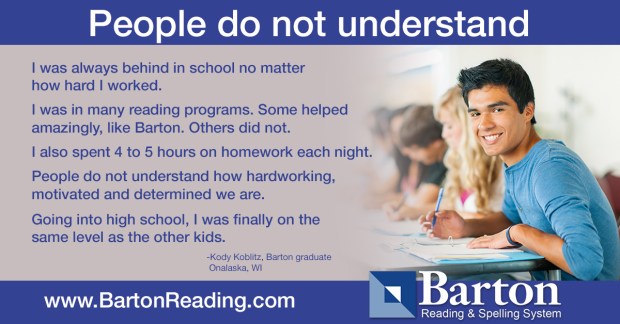
People do not understand
My son Kody completed all ten levels of the Barton Reading & Spelling System. He is now a Junior in high school. He recently wrote this paper for English class. I wanted to share it with you.
Being 17 years old and having dyslexia may not seem like a big deal. But what I’ve had to do to this point in my life may be hard for others to comprehend. For most people, when they hear of someone that has a disability, they feel bad and look down on them.
People do not understand how hardworking, motivated and determined we are.
From the beginning of elementary school to third grade, I was always behind in school and not progressing like other students in my class, no matter how hard I had worked. I was then tested for dyslexia.
Being told I have a disability by my mother was really hard to accept in the beginning; however, it may have actually been one of the best parts of my life.
I finally had an explanation as to why I wasn’t doing as well in school. Teachers finally would stop saying that I “wasn’t trying” or that I just needed to put more effort into school.
I knew that having a disability was not going to cause me to give up. I knew that I would have to work twice as hard as everyone else.
I pushed myself throughout the rest of elementary school and through middle school, trying to get on the same level as my peers. I tried many things — such as doing different reading programs (some that had helped amazingly, the Barton Reading & Spelling System, and others that did not), working with my teachers one-on-one outside of school, and spending every night doing four to five hours of homework when other kids would get their homework done in class.
The one goal I wanted to achieve by high school was to avoid standing out from everyone else. Going into high school, I was finally on the same level as the other kids in my grade.
Having known and experienced just how hard it can be to have a disability, I have insights as to what other kids are most likely dealing with. It may be peers making fun of them, being told they can’t do something just because of their disability, or teachers not understanding how they learn best.
For me, the most stressful part of class was being terrified I was going to be called on to read out loud and then being judged by my peers.
When given a writing assignment, I would sit by myself, away from everyone, so no one would be able to see my writing and laugh at me.
Being someone with a disability, I know that there are always going to be people who will never understand the journey that I, along with many others, have faced; nor what I have done to get to where I am now. I hope that sharing my story will help others understand not only the negatives of having a disability, but also to see the opportunities that are possible.
Through all the struggles I’ve faced and experienced, I have always pushed through and thrived. The biggest advice I can give to someone with a disability is not to be ashamed of it or let it label you as “abnormal” (compared to whatever “normal” may be).
In my case, I would never say, “I’m a dyslexic.” I would say, “I am a person that has dyslexia.”
A disability is one part of who you are; it’s up to you to show the world how you want to be seen.
Koby Koblitz, Barton Graduate
Onalaska, WI
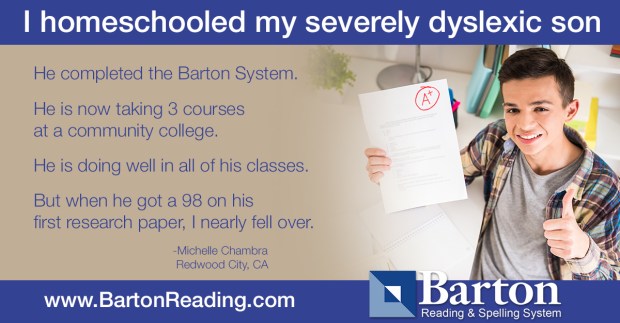
I homeschooled my severely dyslexic son
Our dyslexic kids can do well in college courses, as this parents shares:
I just had to share a success story with people who will understand what it means.
My son is severely dyslexic and was not diagnosed until he was almost 11. At that point, he could not even write simple sentences, and I was homeschooling him.
We just completed Level 10 of the Barton Reading & Spelling System in March.
David is in 9th grade and is taking three courses at the local community college as a concurrent enrollment student: World History, Biology, and Psychology. It has been a challenging semester, but the school has been wonderful about providing accommodations and most professors have been supportive.
He’s doing well in all his classes, but today was a special success. David brought home his research paper for history — the first research paper he’s ever had to write, and it required many primary and secondary sources. He earned 98/100 points!!!
I just about fell over!
I am so proud of his hard work and so thankful for the Barton System and for a school and teachers who are willing to provide needed accommodations. It just shows you what our students can do when they are given what they need.
I hope this encourages some of you who are just beginning this journey.
Michelle Chambra, former homeschool parent
now a Certified Barton Tutor
Redwood City, CA
Writing papers in college was so hard . . .
Adults who never got the right type of help in school say that writing papers in college was nearly impossible, as this person shared:
I just watched your dyslexia video, and my son has almost every single warning signs from preschool to elementary school.
I also have almost every warning sign. I always joked about being “dyslexic” growing up because I was always lost and always getting my left and right confused. But I never realized I had all of the classic signs.
I barely made it out of high school. I never wanted to go back because school was too painful !!!
I did try a semester at the local junior college, but I dropped out when the first writing assignment was given. I knew I couldn’t do it.
Years later, I took a class at a different junior college that was taught by a friend of mine. It was the most painful thing I have ever done. I did not want to disappoint my friend, so I stuck with it.
I agonized over every writing assignment. She couldn’t figure why it took me hours, and even days, to do such small writing assignments. This was before computers. I had mounds of crumpled papers, and I just about killed myself to get through that course.
I got the 2nd highest grade in the class, yet I still felt stupid because I was the only one who had to work so hard in such an easy class.
That was it. I was done with college.
I don’t want my son to go down that same path. What can I do to help him?

The Barton System saved my daughter’s life
I love when parents take the time to send me their child’s success story, like this one:
Dear Susan,
You must get hundreds of messages like this. But I can’t wait to share that my severely dyslexic daughter, who is now in Level 9 of the Barton Reading & Spelling System, just received the Duke TIP recognition award for scoring at the 97th percentile in Language Arts on her Stanford Achievement Test.
Wow! Let that sink in for a moment….
My bottom of the curve, “you need to read to her more” child – who hated school and had to repeat second grade — now devours her school work, and scores in the “Above Average” range, not only in Language Arts, but also in Science and Social Studies.
She LOVES to read now, and she writes the most incredible stories.
When I bring up dyslexia at our parent teacher conferences, most teachers respond with wide eyes and disbelief. They can’t believe she has dyslexia because she is one of their top students.
“But it’s documented in her file. It’s severe. She has an IEP,” I remind them. Sometimes I need to pinch myself to make sure I’m not dreaming.
Last spring, she was 1 of only 7 students in the entire 4th grade who, on the last day of school, successfully passed the “4th Grade Challenge” to correctly spell and identify all 50 states on a map.
She also received an award and prize for the highest cumulative score on all of her spelling tests.
I am so lucky that her worried grandma found the Barton Reading & Spelling System online 3 years ago, and had the courage to order Level 1 and get started. By the end of my daughter’s first week of tutoring, we could tell that Barton was helping her – where everything else we had tried had failed. And she has continued to make great progress.
My daughter is so proud. She openly shares how much Barton tutoring has helped her.
I get teary-eyed just writing this email. What a difference the Barton System, carefully taught by a worried grandma, has made in my child’s life.
I can’t thank you enough.
Judy Stone-Collins, parent and now a
Certified Barton Tutor
New Orleans, LA

Poor spelling is the most obvious sign of dyslexia
I get the most heartbreaking emails from adults who are still ashamed of their spelling.
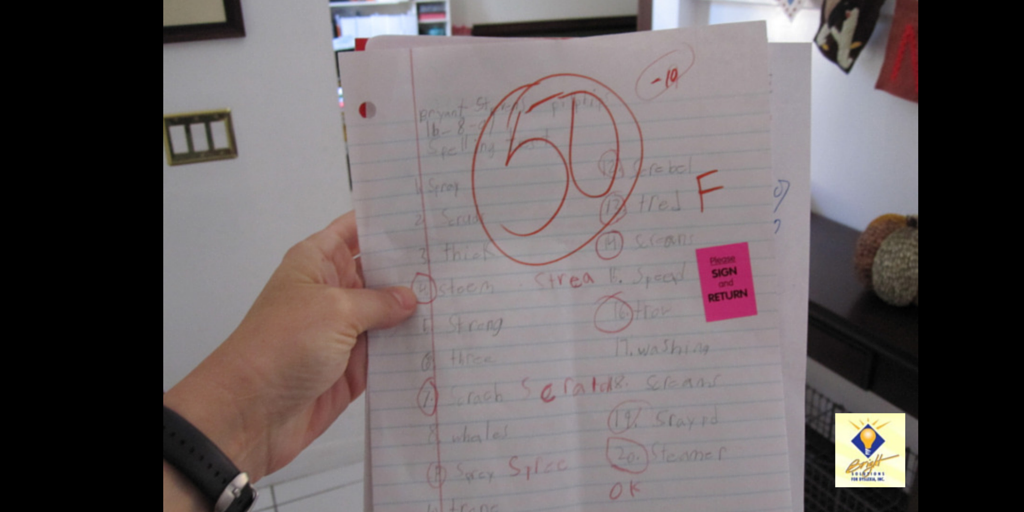
Here is what one had to do to pass her weekly spelling test:
I HATED spelling and am ashamed to admit that I even cheated on my spelling tests.
In fourth grade, my teacher would always ask the words in the same order they were in the book. So I would have a sheet of paper with the words already written out underneath my blank paper on which I “took the test.”
I would then turn in the prewritten sheet. I even purposely wrote a word wrong now and then to make it more believable.
I have never gotten over being ashamed of that.
Or this one:
If you were standing in front of me right now, I would hug you. How different my life could have been if you were around 40 years ago.
I’m 48 years old, dyslexic, and working (I should say struggling 🙂 on a Master’s degree in Communication. I am trying to create a teaching module that will incorporate dyslexia and empathy. During my research, I came across your website and just finished watching your lecture.
It was as if you had been sitting on my shoulder during my entire childhood.
I completely forgot about having my full name written on a piece of paper that my mom tucked into my sock each day — so that I could pull it out and copy it any time I had to write both of my names in elementary school.
Or this one:
I am 42 years old, and I have dyslexia and ADHD.
I have taught myself to read pretty well, but I still have a very hard time writing and spelling. It takes me hours to write a paper.
I was diagnosed in 1976 but never got the right type of tutoring. I graduated on a 3rd grade reading level, and I was in Special Ed classes for years.
Do you think I still have a chance to become a good writer with the right kind of teaching? I still have a very hard time writing and spelling. It takes me hours to write a paper.
In the time it took me to write this email, I could have written a small book. And I never send anything out without checking it many times.
If I could have overcome dyslexia when I was younger, I would have become an attorney or a legislator.
Or this one, from the president of a small company:
I am sending you this letter with spell check off just so you can see what I am deeling with. I am 44 years old I have ben diganocsed with dyslexa when I was a child I was in special classed when going through public shoole. I have allways been able to read slower of corse but I have great compratintion of what I read.
I know own my own mechanical contractiong companie and employ 25 people. I have always been embarsed about my spelling and gramer up untill about 10 years ago. Now I have my office manager proof read everything I send out and half the time I cant read what I wrought down myself. I have gotten to the point in my carrear that I am have been sucsesfull enogh that I don’t care what others think about my spelling and gramer well I guess that is not 100% true or I would not be sending you and email.
The sipelist words through me off have had there were where when I always seem to miss use them I must spell has 50% of the time hase and the same thing with had I spell hade.
It is so tyring trying to send out email that I don’t have time for my assistant the check the spelling and gramer so I send it out after reading it 5 pluss times just to see the next day when I read the email back I left out words completely. I don’t understand how I can read the same thing over and over again and not notice I lift out the or ‘s I seam to do it all the time. My spelling is so bad most of the time there is not another word close enoghf tha spell check can figure it out.
Do you think your program would haelp me deal with this issue or shoud I just have anything I right be proof read?
Yes, the Barton Reading & Spelling System will greatly improve the spelling of children, teenagers, and adults with dyslexia.
And adults with dyslexia are more ashamed of their spelling – than their slow and inaccurate reading.
Never stop doing what you’re doing
This private Facebook post from an adult shares the trauma of going through school without the right type of help — far better than I can.
I just wanted to say thank you for all of the work you are doing for kids with dyslexia. I just finished watching Embracing Dyslexia. You were in it, and I liked what you said.
I was one of the unlucky ones. In the 80’s, they had no idea what was wrong with me. I did not hear the word dyslexia until I was in junior high. By then, I was fighting the best I could just to keep up.
My home life was not great. There was no caring or support from my parents.
Some teachers made fun of me to my face. Others called me lazy. I was accused of not trying or being stupid.
Starting in fourth grade, the school put me in special ed classes. But they put everyone with special needs in the same room. The teacher had to help one kid who was in a wheel chair, a different student who was mentally retarded, one who had behavior problems, and a small group of us in the corner who seemed to be “faking it” because we were bright and smart, but we could not figure out how to read, spell, write or do math.
We did not belong in a class with really handicapped kids. We needed help, but not the same type of help. Friends would ask, “What’s wrong with you? Why are you in the class with the handicapped kids?” I had to answer, “I don’t know.”
Needless to say, my childhood was not fun. I was beaten down mentally and physically.
Mrs. Barton, never stop doing what you are doing. Make sure no other kid has to go through what I went through.
Make sure everyone understands what dyslexia is, and how they can help kids through it.
Warning signs in adults
Since dyslexia is inherited, any adult who has dyslexia should watch for it in their children.
But adults with only mild or moderate dyslexia may not know they have it because they were never tested for it. But they will recognize these classic warning signs.
Lifelong trouble with spelling is one classic warning sign, as this college graduate shared:
Before the invention of the computer and “spell check,” it would take me forever to write a paper. I NEVER wrote letters to friends.
When I asked my mother how to spell a word, she would tell me to go look it up. How the heck can you look up a word if you don’t know how to spell it? I never did understand that. But my mother was a 1952 spelling bee champion, so she had no understanding of my difficulty.
I would spend HOURS going through all of the G’s trying to find the right spelling of jaguar.
Then an English teacher in college took me aside and asked, “Alice, you can’t spell, can you?” I sheepishly admitted I could not. He then asked me how I would spell jaguar. I replied that I wasn’t sure. He asked me if I could spell cat. I said yes. He then handed me a thesaurus and told me to look up cat. And there, under cat, was jaguar.
He then told me he never again wanted me to hand in a paper that was “dumbed down” because I couldn’t spell a word. He was the one who started the ball rolling to get me tested for dyslexia. I was 20 years old and in college.
Although it took forever to write papers, even with a thesaurus, I did get a college degree.
Another classic warning sign is being a very slow reader and having to guess to figure out the longer words – as this man shared:
At 78, I still struggle with dyslexia. Growing up in Tennessee in the 30’s and 40’s, I was viewed as dumb or lazy.
I may not seem as bad as others because I learned how to cheat, and how to avoid English and other courses that required lots of reading or writing. So I made good grades in college – graduating in the top 20% of my engineering class, and then getting an MBA.
But reading is still a lot of work.
And if you are a slow reader with terrible spelling, and you are also unable to master a foreign language, the odds are pretty high that you do have dyslexia – as this woman shared:
My brother’s kindergarten teacher suspected he might have dyslexia, but it took 2 years before he was diagnosed with severe dyslexia.
When I was 12, I attended a Susan Barton presentation on dyslexia with my parents. During her lecture, I realized I was also dyslexic – but I did not struggle as much as my brother. I was just a slow reader and a terrible speller.
It was not until I had to take a foreign language class in college, and failed every language I tried, that my parents finally realized I might also have dyslexia, and had me tested.
If you know or suspect that you have dyslexia, please watch for it in your children – because it is an inherited condition. Not all of them will have it, but about half of them will.

 Bright Solutions for Dyslexia