Spelling
Persistent trouble with spelling is the most obvious warning sign of dyslexia in adults, and it causes stress and embarrassment every day of their life.
Since dyslexia is inherited, some of their children will also struggle with spelling, as this parent shared:
I watched your video because my son is struggling in reading, spelling and writing.
I was in tears as I watched your video. I kept saying, “This is ME. Finally, someone knows why I do the things I do.”
I am 35 years old. I had reading tutors almost every year in school, yet I never understood phonics. I still cannot sound out an unknown word. When I write, I try to think of easy words that I know how to spell. As you can imagine, spell check does not work well for me.
I have a horrible time getting my thoughts onto paper. I get so nervous any time I have to write a note to my children’s teacher. Even writing just this much is hard. I have reread it 5 times – trying to catch and fix any mistakes.
My brother has similar symptoms. He was labeled LD and was in special ed classes. My mom eventually took him out because they were not helping.
I asked my mom the other day if anyone had ever used the word dyslexia to describe me or my brother. She said no.
I do not want my son or daughter to struggle like I did — and still do.
This 47 year old shared:
I really struggle with spelling and depend heavily on spell check. I am too embarrassed to hand write a grocery list due the number of mistakes I will make. I know I am misspelling the words, but I can’t for the life of me figure out how they should be spelled.
Oftentimes, I can’t get it close enough for the spell checker to know what I want.
This woman shared:
In elementary school, I was told I had a learning disability. It was not until high school that my parents had me tested outside of the school system and found out I had dyslexia.
I have had many challenges during my years in retail employment, particularly with cash registers and computers.
Trying to sign customers up for store credit cards, which is mandatory, was just impossible for me and gave me such anxiety. I simply cannot take the answers a customer tells me and get them into the computer.
Customers do not want to have to spell out every word, and to repeat their phone numbers and zip codes over and over again.
So after years of being totally stressed at different jobs, and even taking anxiety medication to try to perform my job adequately, I decided to go to college.
But the junior college will not accommodate me in any way unless I can provide current testing.
I’m a single mother with almost no income. That type of testing is incredibly expensive.
Are there any other options?
This man shared:
I am 56 years old, and I have tried a lot of things throughout my life to overcome dyslexia.
It started when I was in second grade. I can remember my mother crying when she tried to teach me my spelling words.
I attended summer tutoring for 4 years in a row to try to learn to read. Finally, the tutor said he would not work with me anymore because it was a waste of money.
I took phonics in college, but it did not help. In fact, I failed a speech-language class because I could not hear the sounds.
Many years later, I went to a dyslexia center. But they said they could not help me because I was too old.
Your video nailed me to a tee. When you talked about left and right confusion, that’s me.
I always use spell check, and yes, sometimes it does say “no suggestions” or I pick the wrong word from the list because I can’t read them all.
My company is trying to find something to help me. Is it too late? If not, what would you recommend?
And this 56 year old still stresses about spelling:
I have developed ways of hiding my dyslexia.
My spelling is pretty bad, so after I type something and put it through the spell checker, I re-read it five or six more times to make as many corrections as I can.
When I am doing creative writing, my spelling, punctuation, grammar and multiple typos show up much more than if I am writing technical material. Therefore, the more creative my writing is, the longer it takes me to re-read, proof and re-proof my work. You have stated before that dyslexics often work a lot harder than others to produce the same results (even in a simple e-mail) and it is very true.
A couple of months after I was hired as Executive Director of a nonprofit, I sent out a memo to all employees. I had some misspelled words and other minor mistakes in it. I had a couple of “word nerd” employees who immediately pointed out my mistakes (in a friendly and helpful way). But later, I walked into a room and overheard a couple of (not so friendly) employees saying something like, “Where did they get this guy? He can’t even spell right.”
I have been here four years now and have mellowed out a lot. I started sharing with people that I have dyslexia, and even poke fun at myself about it. It has been well received, and I have some great employees who will proofread things like grants and important letters before I send them.
I still obsess about correcting my writing, but not to an unhealthy level. It’s just part of the life of a dyslexic. Compensating takes a lot of extra time, but it’s just become a normal process.
Okay, I have re-read this 5 times. I assume you are rather forgiving of mistakes – so I am not going to read it again.
Retention does not work
Some states have a policy of mandatory retention for students who cannot pass the reading portion of the state standards test. But retention alone does not work – and never has, as this parent shared.
I am 34 years old, and I have struggled all my life with reading and spelling. As a result, I have this record playing over and over in my head that says I’m not smart.
My mother has a photo of me going into first grade. I did not want to go. My head is down, my arms are at my side, and my book bag is dragging along the ground. This was my theme during my entire school career. I hated school from the very beginning. I only wish someone had noticed all of the signs of my dyslexia.
Fast forward to 8th grade. I knew I was struggling – and struggling bad. I don’t recall going to classes most of 8th grade. I don’t know why I passed that grade since I didn’t attend much.
I skipped even more school during 9th grade because I was still struggling and felt stupid. I finally dropped out.
Many years later, I got my GED. I then attended a local community college. I have many credits, but not enough to get my AA. That’s because I have taken “Basic English Composition” 3 times – and dropped out 3 times. It is just too difficult for me.
At 18, I become a mother to a wonderful and incredibly smart boy named Jerry. I did not know the preschool warning signs of dyslexia.
But his kindergarten teacher informed me of his difficulty with letter recognition. Later, in first and second grade, I heard about more of his problems. He was eventually tested by the school, and he got an IEP for an Auditory Processing problem. The tests also showed he had a high IQ.
They advised that I read aloud to Jerry every day so he could hear good reading, which they claimed would teach him fluency. Despite doing that, Jerry “hit the brick wall” in 3rd grade. He was retained because he could not pass the end-of-year state standards test.
When I dropped him off at school during his second time through third grade, it was so hard for me to watch him pass all the other kids in the hallway and go back to the same wing he was in last year. I can only imagine how hard it was on him. It was a horrible year.
Fast forward. My son is now 15 years old and going into the 9th grade. Jerry continues to struggle with reading and spelling – despite getting special ed services for 6 years. He can’t even say the months of the year in order.
I watched your video on dyslexia last night and cried almost the entire way through it. You were talking about me and Jerry. I’m one of “those” kids. So is my dad, my aunt, my sister and my nephew. The inheritance pattern is so clear.
I feel very angry at the school system. I did EVERYTHING they told me to do – but none of it worked. Jerry has adapted and can get by – but even though he is smart, he feels so stupid at times – a feeling I know down to my core. It happens every time he is called on to read aloud in class, or when he can’t spell even simple words.
I am so afraid he is going to drop out – like I did.

What it took to get through college
I love it when teachers attend my free presentations on dyslexia – because they share amazing stories of how hard they worked to make it through college:
A new teacher shared:
I saw you speak about a month ago. Let me first say that you were wonderful! I am a new teacher, 24 years old, and I went with some coworkers. We left thinking that every educator should be required to attend one of your seminars.
I now think I might have dyslexia. I always felt that I was slower to understand things in school because I couldn’t read as well as the other students. I remember my teacher putting me in a remedial reading class. I got out of it by faking that I needed glasses and that was the reason why I couldn’t read. After that, I got really good at faking reading.
I graduated from college after struggling many nights trying to read the textbooks and just giving up. I am sad to admit this, but I am a college graduate who has never read an entire chapter of any textbook. It’s not that I didn’t want to read the books. It’s just that I would start reading, but I would get lost. I kept having to reread the same page over and over again, reading was exhausting, and I could not understand what I was reading because I read so slowly and inaccurately. Yet when someone explained it to me verbally, I would instantly understand it.
Even though I never read a full chapter of any textbook in college, I did end up graduating with an overall 3.1 GPA.
A teacher at a private Christian school shared:
Your talk was amazing. I have a degree in Theology, but I stopped buying textbooks after the first semester because I never read more than the first few pages of them.
Instead, I formed study groups where we would TALK about the subject and share the information that “each person” learned from reading the textbook.
I also loved the literature courses. I could not read all of the words in the books, but I could guess at enough of them to follow the storyline. I also discovered that many of “the classics” could be downloaded as text files, so I could use Dragon Naturally Speaking to read them out loud to me.
A teacher pursuing her Master’s degree shared:
I am 56 years old and have dyslexia. I see myself in so many of your descriptions: the disorganized desk with piles of paper, the messy room, the right versus left problems, and spelling. Lord, I can’t spell anything.
Technology tools, especially spell and grammar checkers, have been a saving grace for me. I use them constantly. My wonderful husband has also read and corrected the spelling, punctuation, and grammar in my papers, my emails, and my class work for the last 30 years.
I am now going for a Master’s degree. It is sooooo frustrating that I can make A’s on all of my discussions and demonstration classes, but I can barely get a C on multiple choice tests. I run out of time on every test because when I read the questions, I skip words or misread them. So I have to check and recheck to be sure I’ve read each long convoluted question, and each possible answer, correctly. I can then choose the correct answer, but it takes me longer. Time always runs out before I finish the test.
From a caring teacher and friend:
When you mentioned that dyslexics have poor written expression – even though they have a clear grasp of the concept when discussing it orally, I thought of a young lady I met in college. We started out studying together, but eventually, I became her scribe. When we discussed a topic, she clearly knew what she was talking about. But when she came back with a paper she had written on that same topic, it made very little sense. She would ask me to look over and edit her papers, but this was such a struggle for both of us (her during the original writing, and me during the proofreading) that it simply became easier to write together sitting in front of the computer. She would talk, and I would type.
She shared that she had a reading and writing learning disability and had gotten an IEP in third grade. She also shared that she had been told by several teachers that she was unlikely to graduate from high school and probably would never be able to attend college.
But she had an amazing work ethic. She worked her butt off. And she earned a Master’s degree in Elementary Education and graduated Magna Cum Laude.
Her story stuck with me, and I’ve been so angry at those teachers who dared to make such a negative prediction to this obviously bright young woman. I can’t help but wonder how different her educational experience would have been if only her teachers had known about dyslexia.
I do not want to fail at homeschooling . . . again
Homeschooling can make you feel like a failure if you do not understand why your child is struggling, as this parent shared: [audio https://susanbartondyslexiastories.com/wp-content/uploads/2013/02/i-do-not-want-to-fail-at-homeschooling-again.mp3]
How do you homeschool a child with dyslexia?
I ask because I pulled my 2 very bright children out of public school at the end of first grade when they were struggling so much that they dreaded going to school. I did not know they had dyslexia at that time, and I was sure that I, a loving college-educated parent, could do a much better job of teaching them myself.
But that homeschooling year was one of the most humbling, emotionally taxing, and frustrating years I have ever had. My children’s resistance to my reading and writing instruction, and their terrible spelling no matter how much I drilled them, often brought me to tears. I thought they were not trying hard enough and were being ornery on purpose. So I often punished them in order to get better performance.
At the end of that homeschooling year, I felt like an utter failure. Their skills were not much better, and my relationship with them had changed from being a loving nurturing mom to a dreaded and harsh teacher.
So I put them back into public school for third grade. Yet we continued to fight during our nightly “homework wars.” Assignments most kids could do in 30 minutes were 2 to 3 hours of h***.
It wasn’t until November that someone suggested my children might have dyslexia. After private testing confirmed it, and after discovering their public school does not offer the type of reading and spelling instruction they needed, and neither do the private schools in my area, I am considering homeschooling them again.
I know I can use the Barton Reading & Spelling System for language arts, but how to I teach the other subjects, such as math, history, and science – when they are so far behind in reading, writing, and spelling?
That is such a common question that Susan Barton created a free 30-minute on-line presentation for homeschooling parents – that is also good for parents who are thinking about homeschooling.
To watch it, click on the following link, and when asked, type in your first and last name.
https://student.gototraining.com/705xt/recording/7932953641034945024
To download the handout that goes along with that presentation, click on this link:
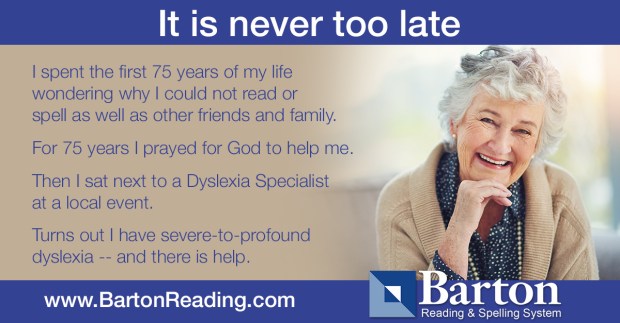
It is never too late
The following adult had received one year of Barton tutoring when she wrote this letter to Oprah (with the help of her tutor) to try to convince Oprah to do a show on dyslexia.
Dear Oprah:
I am 76 years old today.
I spent the first 75 years of my life wondering why I could not read or spell as well as other friends and family. I didn’t know why I had such a hard time finding the right word when I spoke, or why I couldn’t say the words correctly when I could retrieve them.
I didn’t know why I so often got lost in cities I had lived in for years, or why I still had to stop and think for a moment before I knew my right from my left. I didn’t know why I had such trouble memorizing things that seemed so easy for others.
Or why someone like me – someone who has started and run two businesses – could still not read well, or spell correctly enough to take a message and then be able to read it afterwards.
I didn’t know that I had severe-to-profound dyslexia.
For 75 years I prayed for God to help me. Last fall, I prayed again – that God would please, PLEASE, send me someone who could teach me how to spell.
The very next day, I ‘just so happened’ to sit next to a Dyslexia Specialist at a local event, and we ‘just so happened’ to strike up a conversation about what she does for a living. She ‘just so happened’ to tell me about the signs and symptoms of dyslexia, and I immediately recognized them in me.
Best of all, she ‘just so happened’ to tell me that there are solutions! That people who have struggled with dyslexia, for even 75 years, could still learn to read, write and spell! I made an appointment for her to test me. I cried when she told me that I had dyslexia. They were not tears of sadness, however. They were happy tears! Tears of joy! I finally had an answer!
I have been receiving the right kind of tutoring, twice a week, for a year.
I read the word authentic for the first time last month. I can now spell words that I could not even say before. I am 75 years old. Believe me – there is hope.
I have been thinking back on my 75 years. I thought of the very worst time in my life – the time when my daughter died.
Then I thought of the very best time in my life – it was the time I realized I could learn how to spell! When I finally, finally, realized what my life’s problem was. I am dyslexic.

 Bright Solutions for Dyslexia