Going to school each day is an act of courage
This is why our bright kids with dyslexia often develop anxiety or depression — and dread going to school.
Jessica Spriggs sent this to me as an email, and gave me permission to share it. She wrote:
I’m very proud of both of my kids, but only Olivia wakes up every day knowing that she will face huge hurdles throughout her school day.
Lately, it has been extremely hard to convince her that going to school is a good idea.
She sits in class feeling defeated because she learns differently than most of her classmates.
She struggles getting through homework.
And even though she studies for tests, she may barely pass a test. She knows the material inside and out, but to apply it in the traditional way seems impossible at times.
Her teachers rave about her huge vocabulary, her poise, her generosity, and her creativity.
But there is always that moment when she feels like giving up.
Maybe it’s when her name is not posted for honor roll because she just could not make A’s and B’s despite hours of studying.
Maybe it’s when she has to think about which hand is her right hand, and she gets confused.
Maybe it’s the overwhelming pressure she feels when she knows she has to take a standardized test soon — and wonders if she can pass on to the next grade.
She has lots of anxiety, but this girl has gained strength, grit, power, endurance, and most of all, a backbone to handle everything thrown her way.
She is the face of dyslexia, but she will not let it define her!
She will concentrate on the things that make her happy: being kind, sewing, artwork, and public speaking.

Start now. Don’t Wait.
I am thrilled when parents follow my advice – and then let me know, years later, what impact it had on their children, as this parent did.
Susan Barton saves lives daily. She is one of the lights in the dyslexia world because she cares, and like the dyslexic people she helps, she FINDS A WAY to get things done.
I love and respect Susan Barton for all she has done for our family. I homeschooled my gifted and profoundly dyslexic sons using the Barton Reading & Spelling System.
They are now in high school, earning college credits. One is captain of the Lacrosse team. They have started a mentoring program in their high school for kids who are dyslexic, and they are a part of a Teacher Training program at the university.
They are alive, thriving, and making an impact on the world because Susan Barton took the time to talk with me, encourage me, and provide me with the tools necessary for my children to reach their FULL potential.
Her system is solid. It is accessible to the uncertain, untrained, confused, scared parent who wants their child to soar.
START NOW. DON’T WASTE ANOTHER MINUTE !
I followed that advice from Susan Barton, and now as the founder of Decoding Dyslexia Montana, and a trained advocate, speaker, teacher trainer, and tutor, I preach the same. START NOW . . . regardless of what the school does or does not do.
Take care of your child.
Kelly Fedge-Dubose, Founder
Decoding Dyslexia Montana

I feel so lost and alone
Almost every parent I meet has gone through an experience like this:
Susan, I feel stuck, and I need some advice. My son is having a rough year in 5th grade. After reading some of the articles on your website, I am sure he has dyslexia.
He struggled so much in first grade that his teacher thought he had a Learning Disability. But the school said he was too young to test.
Over the years, he has made some improvement because he works hard, is a pleaser, and most of his teachers love him. In fact, he got straight A’s in 4th grade — with TONS of hard work.
But this year, he has had a one-two punch: a teacher who is not so great, plus he is hitting the “read-to-learn” wall.
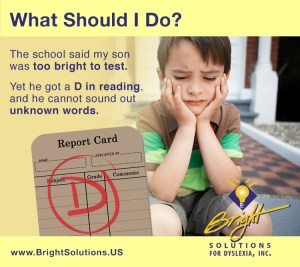
I am getting nowhere with the school. They claim he tests “on level,” yet he got a D in Reading on his report card – which seems to alarm no one. When I went to his teacher with my suspicions of dyslexia, she said that in her 23 years of teaching, she had only known 1 kid with dyslexia.
The Principal (who has a background in Special Ed) said my son might have some decoding issues. So he set up a Child Study Team meeting. But t he team said he was too bright to need help.
I tried to tell them that my 5th grade son just now, finally, learned to tie his shoes (using his own wacky, two-loop method), he cannot name the months in order, and he cannot play a game like Apples to Apples where he has to sound out a word in isolation. So they had the reading specialist assess him. She indeed found some “decoding” issues. She sent home a first grade chunk-matching game. That’s it. I am dumbfounded.
I feel lost and alone with no way to help my son. I live in a town with TWO teaching universities, yet I cannot find anyone who tests for dyslexia, or any professional tutors who are certified in one of the good Orton-Gillingham based programs.
How do I advocate for my child in a school system that deems him too bright?
Since dyslexia affects 1 in 5 kids, I can’t be the only parent feeling so helpless – and so worried about middle school.
Barton System is a Life Changer
The right type of tutoring changes everything — as this parent shares:
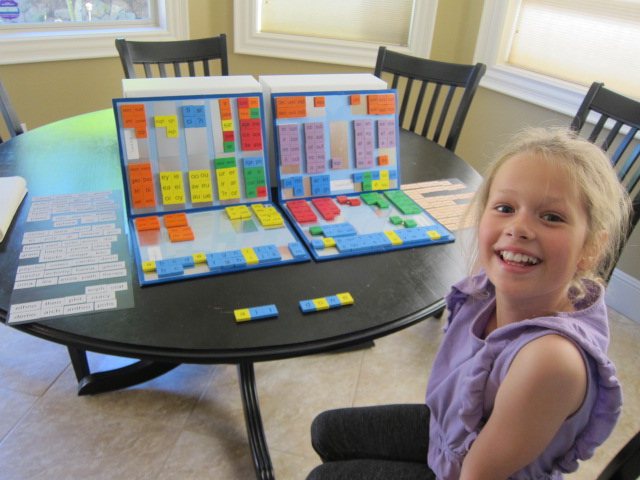
The Barton System changed my daughter’s life. She COULD NOT read or spell at all. She was diagnosed with dyslexia in 1st grade, and we immediately started her on this system. I purchased levels 1, 2 and 3 and tutored her myself.
It is incredibly easy to learn this system and then teach it. Susan Barton has done an exemplary job of making a product that will benefit both the student and the tutor.
My daughter finished all ten levels and is now in 9th grade. She is reading well above grade level, loves sitting in her room reading a novel, and has an A in English — for the third year in a row. She understands the rules of spelling, she knows the strategies needed to read and comprehend, and she is ever so happy.
If you are hesitating on starting your child on this system – DON’T. You will not regret it at all.
I will warn you that it is sometimes tedious and frustrating; however, it makes sense. I will not lie and say that she loved every minute of tutoring. However, she made an enormous amount of progress fairly early on, which gave her the encouragement to keep going.
I cannot emphasize enough just how wonderful this product is. Susan Barton knocked it out of the park with this one. Best purchase ever.
Donna Gisbert, parent
Lakewood, CA

The importance of early intervention
If you have ever watched one of your own children struggle for years in school due to undetected dyslexia, you will step in faster when your next child starts to struggle – as this parent did.
Our story is so similar to other families I have met: the daily homework struggles, tears of frustration over a worksheet that takes other kids only a few minutes to complete, “wait and see” advice from some teachers, and “your daughter is too smart to be dyslexic” from others. I have never felt so helpless.
But when Lillian was in second grade, we were so lucky to have a teacher who pulled me aside and recommended we go outside of the school system to get a private evaluation, and lucky that the evaluator recommended the Barton Reading & Spelling System.
When we started the Barton System, Lillian was in the spring of second grade, reading at a beginning first grade level. We worked very hard to close the gap, tutoring 30 minutes every day (and increased it to an hour a day during the summer).
When Lillian took her state reading test in the spring of third grade, she scored in the “meets grade level” category – only 4 points away from “exceeds.”
Now, after her second year of tutoring, she is able to read books at her interest level, and we often catch her reading just for fun – which means more to us than any test result. The growth we have seen in her confidence and self-esteem is priceless.
I have also benefited from your program. It is so empowering to finally be able to understand how to help my kids learn to read, and to speak knowledgeably with their teachers.
But more importantly, I was able to avoid struggle and failure with my younger son Nate, who was 5 1/2 when we had his sister evaluated. Nate had almost every early warning sign for dyslexia. So I started working with him at that time (in shorter sessions), and he has learned to read solely through the Barton System. We had him privately evaluated at the beginning of his first grade year, and Nate was reading at a mid-second grade level!
Nate is a poster-child for the importance of early intervention. I recently spoke about my experience tutoring my own kids when I testified before the Oregon Senate Committee on Education in support of our dyslexia bill.
Thank you again for creating such an accessible, affordable program, and for being so helpful and available when I had questions. My kids now have a limitless future, and your program allowed me to give it to them. We are so incredibly grateful.
Theresa Sorensen
Happy Valley, OR
Homeschooling takes a lot of courage
It takes a lot of courage to pull your child out of public school and start homeschooling. And it requires a lot of work. But most parents of children with dyslexia will tell you that homeschooling was the best thing they ever did.
This homeschool parent’s story is so typical.
Susan, I just have to share what that my son’s (homeschool) teacher posted today. We are on Level 4 of the Barton Reading & Spelling System. He is in 4th grade.
Last year, in public school, he hit the “brick wall” and cried every day. He hated school. He hated the fact that his little sister could read better than he could. His self-esteem was nonexistent. The school refused to do ANYTHING even though we had a diagnosis of dyslexia.
So this year, in an effort to salvage whatever self-worth he had left, we decided to homeschool.
Today, I received this email from his homeschool teacher. THIS is what happens when you use EVIDENCE BASED methods that are proven to work with a dyslexic child!
Subject: Music to my ears
My son: I’m going to have to read all the way home because I want to know what is going to happen next. Can I just read it now?
Teacher: No, that’s homework.
My son: But I want to know now.
This is coming from a boy who has NEVER enjoyed reading in his life because of dyslexia and the use of ineffective reading methods in the past. Now he can’t put his book down. Proud teacher moment!
Susan, thank you for everything you do to help our kids, and to educate us and guide us in advocating for them along this rocky journey. You are an angel to many.
Cindi Bighinati
Homeschool parent in CT

Special Ed Teachers Can Also Be Heroes
I recently received this heartwarming email from a Special Ed teacher, who is also one of my heroes.
I am having amazing success using the Barton System in my resource room.
A young man transferred to my school at the beginning of 7th grade, barely able to read at a second grade level. He absolutely hated school and was often absent.
His parents had tried everything. They had spent thousands of dollars sending him to Sylvan and to private tutors.
They heard about the success I was having with the Barton Reading & Spelling System. After his school refused to get the Barton System, they fought for 2 years to get an inter-district transfer so he could attend my school and work with me.
He is about to graduate from 8th grade with excellent grades, perfect attendance, and is now reading at a 7th grade level. He was even elected by his peers to be their Student Body President.
Yet there is no one at the high school he will attend next year who teaches the Barton System. So a group of my students (who are now in the higher levels of the Barton System) are determined to start a Barton tutoring program there – and they have volunteered to be the tutors.
Geri Linari, Special Ed Teacher
Cuddleback Elementary
Fortuna, CA

Not eligible for special education
Many children with dyslexia will not be eligible for special education services – not even if a parent brings in a diagnostic report.
In that case, fight hard for classroom accommodations – and get the right type of help after school.
This parent did not do that – and regrets it.
Dyslexia runs in my family tree. My father, who is 60, can still remember being in second grade and having the teacher call him up to the front of the class to read out loud. The teacher would force him to stand there and “do it until you get it right” – despite him crying in front of the entire class.
I have a degree in Elementary Education, but we never had a single solitary course – not even a single lecture – on dyslexia.
Yet when my daughter struggled in kindergarten, her teacher suggested the possibility of dyslexia because:
- On DIBELS, she was not meeting benchmarks in nonsense word reading
- She had terrible spelling and could not retain her spelling words — not even the high frequency words like “some”
- She already had 2 years of speech therapy for R’s and L’s, but was not improving
- She constantly confused left and right
- And she still could not tie her shoes
At end of first grade, I asked the school to test her for a possible learning disability. The school said they wouldn’t test her until at least 3rd grade.
So during second grade, when she was not making progress in Tier 2 of RTI, I hired a highly qualified private professional to test her. She was diagnosed with moderate-to-severe dyslexia.
But when I shared that report with the school psychologist, he stated that dyslexia does not exist, that Susan Barton’s website was not a valid resource, and we could not even get a 504 Plan because he felt our daughter did not need it. He claimed she displayed no difficulties and would prove to be a good student.
Her teachers and even the principal were at that meeting, and they went along with the psychologist’s assessment – leaving us to wonder if we really knew what we were talking about.
We were so confused that we decided to follow the school’s advice — and regret it.
Our daughter is now at the end of third grade. Despite another year of phonics instruction and more RTI, she still struggles with spelling, sounding out longer words, and cannot comprehend her science textbook when she reads it herself. (But she has no trouble comprehending it when I read it TO her.)
The school did eventually test her, but her scores were not low enough to qualify for Special Ed services. And her report card grades are not too bad. She gets low B’s or C’s.
We have shown our daughter’s diagnostic report to other dyslexia professionals and organizations, and they have all agreed that she definitely does have dyslexia.
So what do I do now?


 Bright Solutions for Dyslexia