Dyslexia runs in family trees
Dyslexia is genetic. It runs in family trees. So if you see the warning signs in your child, you may also start to identify other people in your family who have it, as this parent shared.
I just watched your on-line video which had so many “ah-ha” moments in it. You might as well have used our son’s name, Sam. Sam has every symptom you described. I feel like you know him personally, and finally, there is someone who understands him.
I have to give credit to his reading tutor, as she is the one who warned us that he “may” have dyslexia.
I now understand my mother better. She’s one of those who gets tongue tied when saying multi-syllable words, hates to write (and no one can read her handwriting), is a terrible speller, skips over the big words when reading, did not learn to talk until age 3, struggled in school – even though she is a very bright and creative person who thinks outside the box, gets lost easily, cannot remember left from right, and the list goes on and on.
And I think I have a mild case of it as well. It bothered me that I was always in the lowest reading group in my class, and that I had to re-read things 2 or 3 or 4 times to understand them.
I even took a speed reading course in high school to try to improve my ACT college prep results – because there was such a big difference between my reading test score and all of my other scores. But the speed reading course did not help my reading score at all. Now I know why.

To watch that dyslexia video, click on this link:
http://www.dys-add.com/videos/dyslexiaSymptomsSolutions_Part01.html
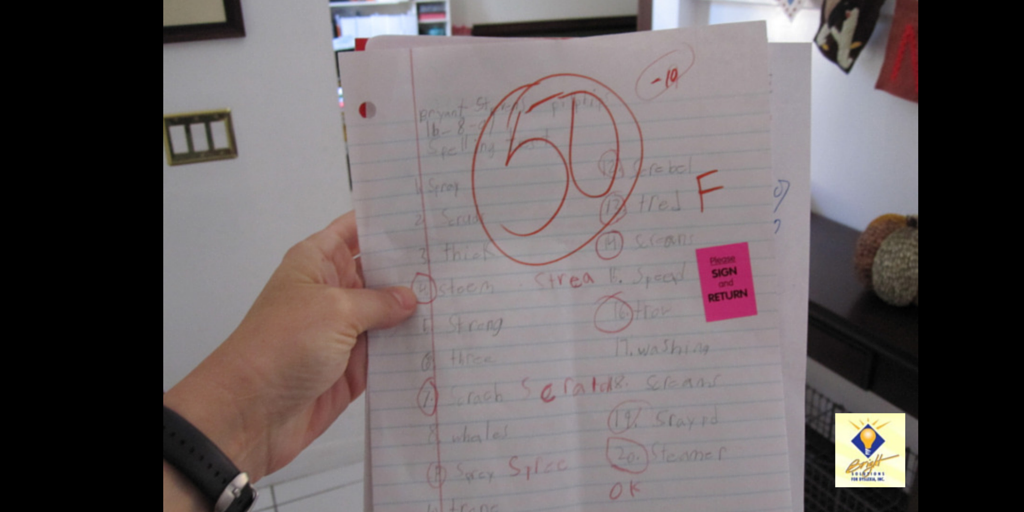
Poor spelling is the most obvious sign of dyslexia
I get the most heartbreaking emails from adults who are still ashamed of their spelling.
Here is what one had to do to pass her weekly spelling test:
I HATED spelling and am ashamed to admit that I even cheated on my spelling tests.
In fourth grade, my teacher would always ask the words in the same order they were in the book. So I would have a sheet of paper with the words already written out underneath my blank paper on which I “took the test.”
I would then turn in the prewritten sheet. I even purposely wrote a word wrong now and then to make it more believable.
I have never gotten over being ashamed of that.
Or this one:
If you were standing in front of me right now, I would hug you. How different my life could have been if you were around 40 years ago.
I’m 48 years old, dyslexic, and working (I should say struggling 🙂 on a Master’s degree in Communication. I am trying to create a teaching module that will incorporate dyslexia and empathy. During my research, I came across your website and just finished watching your lecture.
It was as if you had been sitting on my shoulder during my entire childhood.
I completely forgot about having my full name written on a piece of paper that my mom tucked into my sock each day — so that I could pull it out and copy it any time I had to write both of my names in elementary school.
Or this one:
I am 42 years old, and I have dyslexia and ADHD.
I have taught myself to read pretty well, but I still have a very hard time writing and spelling. It takes me hours to write a paper.
I was diagnosed in 1976 but never got the right type of tutoring. I graduated on a 3rd grade reading level, and I was in Special Ed classes for years.
Do you think I still have a chance to become a good writer with the right kind of teaching? I still have a very hard time writing and spelling. It takes me hours to write a paper.
In the time it took me to write this email, I could have written a small book. And I never send anything out without checking it many times.
If I could have overcome dyslexia when I was younger, I would have become an attorney or a legislator.
Or this one, from the president of a small company:
I am sending you this letter with spell check off just so you can see what I am deeling with. I am 44 years old I have ben diganocsed with dyslexa when I was a child I was in special classed when going through public shoole. I have allways been able to read slower of corse but I have great compratintion of what I read.
I know own my own mechanical contractiong companie and employ 25 people. I have always been embarsed about my spelling and gramer up untill about 10 years ago. Now I have my office manager proof read everything I send out and half the time I cant read what I wrought down myself. I have gotten to the point in my carrear that I am have been sucsesfull enogh that I don’t care what others think about my spelling and gramer well I guess that is not 100% true or I would not be sending you and email.
The sipelist words through me off have had there were where when I always seem to miss use them I must spell has 50% of the time hase and the same thing with had I spell hade.
It is so tyring trying to send out email that I don’t have time for my assistant the check the spelling and gramer so I send it out after reading it 5 pluss times just to see the next day when I read the email back I left out words completely. I don’t understand how I can read the same thing over and over again and not notice I lift out the or ‘s I seam to do it all the time. My spelling is so bad most of the time there is not another word close enoghf tha spell check can figure it out.
Do you think your program would haelp me deal with this issue or shoud I just have anything I right be proof read?
Yes, the Barton Reading & Spelling System will greatly improve the spelling of children, teenagers, and adults with dyslexia.
And adults with dyslexia are more ashamed of their spelling – than their slow and inaccurate reading.
Homeschooling with the Barton System
Susan Barton loves getting emails like this:
My son, Tom, is about to turn eight and has been struggling with reading since kindergarten. Even at that age, asking him to sit down and read for ten minutes resulted in tears. But we forced him to try.
In first grade, kids in his class were correcting his reading mistakes. He felt very bad about himself. He would often come home sullen and exhausted. He was unable to read anything on his own. He needed help with even the simplest of books.
But he was a great guesser and could figure out a lot from picture clues and context. In fact, the school actually encouraged children to guess at words. But Rick had no strategy to figure out a simple word or sentence, so if there were no pictures, he would simply give up.
By the time he reached second grade, it was obvious that all the hours spent reading at home (and at school) were not helping. He still had no clue how to sound out words.
So last January we took him out of public school and enrolled him in an online charter school in a desperate attempt to help him here at home. That’s where you come in.
That charter school asked us to watch your dyslexia video, which explained things so clearly. We then realized Tom has dyslexia – as does his father. Thankfully, that online charter school had a site license for the Barton Reading & Spelling System, so we were able to get it through them.
Your program has been a miracle for us. We are finishing level 3, and Tom is starting to read on his own. He chooses books for himself and delights in reading them to us. He is so happy and proud of himself.
Thank you for the time and effort it must have taken to develop your program and create those training videos.
Susan Barton is thrilled that so many virtual charter schools – which support home educators – are now providing parents with the Barton Reading & Spelling System.
If you are homeschooling, or thinking about it, watch Susan Barton’s free 30-minute video with advice for homeschoolers by clicking on this link:
http://www.bartonreading.com/index.html#homeschool

The problem with “Third Grade Guarantee” laws
Many states have recently passed, or are working on, a “Third Grade Guarantee” law, which includes mandatory retention for third graders who do NOT pass the reading portion of the end-of-year statewide exam.
Pam Collier, a parent in Ohio, gave me permission to share her email that explains why that law is as bad for students withOUT dyslexia as it is for those who do have dyslexia.
From: Pam Collier
Date: August 19, 2014
Subject: Third grade guaranteeDear Superintendent of Public Instruction at the Ohio Department of Education:
I am writing out of concern for my three children and Ohio’s Third Grade Guarantee. I have three very different children, and the guarantee will effect each of them differently.
First, I have a 10 year old daughter who is accelerated. She has tested in the gifted range on her Terra Nova, and has scored well above the cutoff of the guarantee scoring — in the Accelerated range for math and reading.
Now you are probably wondering how the guarantee could have any effects on this student. Actually, it has had a huge impact. My daughter spent her entire third grade year being “taught to the test.”
Teachers are terrified of poor test scores which negatively impact their evaluations. Instead of challenging bright young minds, the system is telling these students, “We don’t care whether you have a special gift. We just need you to do well on this test.”
My daughter was afraid of failing the test because teachers are creating so much anxiety and placing way too much pressure on our students.
Now, I have a second daughter who is a twin. She is 7 years old. Because she is a twin, I started to notice differences in her learning very early. At the age of 4, I began asking if she was dyslexic, citing she was having trouble remembering letters, numbers, rhyming, etc. I was assured that she was fine, and that her twin (my son) was just advanced.
Fast forward to kindergarten, and first grade. I asked the same questions.
In my gut, I knew I had to do something. So I pursued outside professional testing for my daughter. She was diagnosed with dyslexia, attention deficit disorder, and a visual processing disorder.
We tried getting help through the school on several occasions, and were told, “We don’t do one-on-one tutoring, we don’t have the funds for that, we don’t have anyone trained to provide the remediation your daughter needs.” So I hired an Orton Gillingham tutor who was recommended by the International Dyslexia Association.
Now, because she is not on an IEP, she is not exempt from the guarantee. Not exempt!
A child with dyslexia, a visual processing disorder, and attention deficit disorder is not exempt from retention because of a single test? A child whose parents are paying over $5,000 a year to a private tutor because her public school cannot meet her needs? A child who was not identified by the school, but was identified because her parents paid for private testing?
A child who works 5 times as hard as a student without dyslexia to learn, who is also working outside of school with a private tutor, may be retained because of a single score on a single test on a single day, in a single year?
Now, mind you, if she should fail and be retained, the state has mandated that she receive remediation “from a qualified instructor, trained in the remediation of students with a disability in reading, from a program that is approved by the state board of education.” This, from the same school system that said, “We don’t have the time, funds, or individuals with training to help your daughter.”
The same school system that told my husband and I that our goals “were too high” for our daughter. Our goals were that she meet the same benchmark as her non-disabled peers by the end of her second grade year. Our goals were too high? That is what we were told. We are being told that we should not hold our daughter by the same standards due to her disability, yet she will be held to the same standard when taking the OAA.
The Third Grade Guarantee is not serving our children’s needs. Research has shown that retention will lead to higher dropout rates. Teaching to the test is devaluing our greatest young minds. We need to have teachers who can challenge our most gifted students, and specialists who can remediate our students with learning disabilities.
We are doing the very best we can for our daughter. My husband and I are both professionals, and we know what is working for her. What recourse will we have if our bright daughter with dyslexia, a visual processing disorder, and attention deficit disorder, fails the OAA? She will get held back for what purpose? To receive the “extensive remediation” she is already receiving privately?
Why is it a mandate to retain some of our brightest individuals based on a single test?
Why are charter schools not held to the same standards?
Why do public school students have to undergo more than a dozen standardized tests, while private school students do not?
When will educators from the Ohio Department of Education realize that retention is not the answer?
Sincerely,
Pamela Collier
Sports
I get emails like this all the time, and they always bring me to tears.
When I heard you speak on Thursday, I cried. I wish I had that information when we began our journey.
My 17 year old son, David, is dyslexic. He was diagnosed when he was 8, and he has had lots of tutoring at Sylvan and from retired Reading Specialists over the years, which has helped a little bit.
David is a really smart, handsome, and well-liked young man. He hides his dyslexia well. Yet it is still there. After your presentation, I asked him, “What letter comes after S?” He quickly responded, “R.” I shared that was “before,” not after. He then said, “I know what you’re doing. Don’t even ask me about the months of the year.”
When he played PeeWee football, he always wore a wristband so he could tell left from right.
David recently gave directions to our house to his new girlfriend. But he frequently told her to turn left instead of right. After 45 frustrating minutes, he finally handed me the phone and begged, “Please get her here.”
He is a gifted athlete and would like to play football in college. But his grade point average is only 2.65 due to his failing French (a D) and algebra (also a D). He must also pass the ACT (college entrance exam). We paid for an ACT prep course, but after the course, he only scored 13. He needs at least a 17.
He needs extra time on the reading portion, and he dreads math. He was so nervous because he knew he was not going to have enough time to finish the test. How do I go about getting him more time on the ACT?
He feels he is not smart enough to make it in college. The many days of sitting in the hall, being put in “the dumb class” (as he called it), and being teased by his peers does not go away.
But I want him to be able to follow his dream. I do not want him to join the military, which is his backup plan.
Never stop doing what you’re doing
This private Facebook post from an adult shares the trauma of going through school without the right type of help — far better than I can.
I just wanted to say thank you for all of the work you are doing for kids with dyslexia. I just finished watching Embracing Dyslexia. You were in it, and I liked what you said.
I was one of the unlucky ones. In the 80’s, they had no idea what was wrong with me. I did not hear the word dyslexia until I was in junior high. By then, I was fighting the best I could just to keep up.
My home life was not great. There was no caring or support from my parents.
Some teachers made fun of me to my face. Others called me lazy. I was accused of not trying or being stupid.
Starting in fourth grade, the school put me in special ed classes. But they put everyone with special needs in the same room. The teacher had to help one kid who was in a wheel chair, a different student who was mentally retarded, one who had behavior problems, and a small group of us in the corner who seemed to be “faking it” because we were bright and smart, but we could not figure out how to read, spell, write or do math.
We did not belong in a class with really handicapped kids. We needed help, but not the same type of help. Friends would ask, “What’s wrong with you? Why are you in the class with the handicapped kids?” I had to answer, “I don’t know.”
Needless to say, my childhood was not fun. I was beaten down mentally and physically.
Mrs. Barton, never stop doing what you are doing. Make sure no other kid has to go through what I went through.
Make sure everyone understands what dyslexia is, and how they can help kids through it.
Even teachers are frustrated
Once teachers or reading specialists learn about dyslexia, they start to realize how many of their struggling students have it. But when they try to share that with their fellow teachers or administrators, they often run into roadblocks – as this teacher shared.
Hi Susan,
I am a reading specialist at a public school in New York. We spoke briefly by phone a few months ago because I was concerned about my 4th and 5th grade students who are not making much progress.
I watched your videos, visited several websites, and read Sally Shaywitz’s book, Overcoming Dyslexia. I am convinced they have dyslexia.
But after I shared my concern with my principal and the other teachers, things at school have become a nightmare. I have been accused of making the teachers feel inferior when I share that many students need a different type of reading instruction. They claim to have years of teaching experience, and they know what they’re doing. Yet many of these students will be passed on to middle school still reading at a second grade level.
When I talk to the resource room teacher about dyslexia, he looks at me as if I have 3 heads.
I am no longer invited to student support meetings or IEP meetings.
I don’t know how to continue in the uphill battle. I know this is a lot to throw at you, but I really don’t know who else to turn to. I have sent my principal links to your videos, and I have summarized the findings of Overcoming Dyslexia. But everyone seems indifferent, and I am now perceived as a villain.
I know my students need more support. It hurts so much to see them suffer. I am committed to helping them reach their potential. But I feel so deflated and so stuck.
I need a plan for how to continue to advocate for them. I’d appreciate hearing your thoughts.

 Bright Solutions for Dyslexia