Tag Archives: tutoring

Parents Are Frustrated

I get emails like this every single day.

I have been trying to get my son’s school to test him for dyslexia or a learning disability. But they refuse. They say my son gets good grades, and I should be proud.

I am proud of my son, but he struggles with reading and spelling. Homework that takes children without dyslexia 30 minutes takes my son over 2 hours – with lots of frustration, yelling, and tears.

I also had dyslexia as a child.

What surprises me is nothing has changed in our schools.

Parents, if you think special education services are the answer, read this.

My son is going in 4th grade but is reading on a 2nd grade level. His spelling is also very low, and he is dysgraphic.

Although he has an IEP, I have seen very little improvement over the past 2 years.

The worst part is he has given up on learning. He claims he just doesn’t care. It’s very hard to engage him in any kind of learning at school. He would rather act up than learn.

Many children would rather be thought of as “the bad kid” . . . than “the stupid kid.”

The worst part of struggling academically for years . . . is what it does to a child emotionally, as this mother shares:

Susan, I just watched your video. It made me cry.

I have known for months now that my youngest daughter probably has dyslexia. She has been devastated by school and her inability to read. This bright child is sinking deeper and deeper into despair … about school … and about herself.

I cried because I realized that my brother probably suffered from this as a young boy, I probably have this to some degree, and so does my oldest daughter. I did not realize there was such a strong genetic link. How could I have missed this?

I know my daughter needs specialized teaching, and I am trying to get this help from her public school. She has an IEP, but they don’t seem to be giving her the right kind of teaching to get her reading on track. They seem satisfied in sending her on to 3rd grade “with support.”

I do not believe support is going to solve the problem. She needs to be taught in a way that she can actually learn.

Parents, stop waiting for the school to change.

If your child’s school does not provide intervention using an Orton-Gillingham based system by someone who is well trained and uses it properly, then hire a private tutor to provide it during the summer – or get the Barton System and tutor your child yourself.

To learn more, go to:
www.BartonDemo.com

A child’s skills can improve tremendously over the summer – if they get the right type of tutoring.

Do Not Wait

Schools often tell parents of struggling students to wait, as this parent shared:

I need some help to decide what to do for my eight year old son. He is finishing second grade, but he has never read at grade level.

The principal wanted him to repeat first grade, but my husband and I refused, so he was sent to second grade. He has worked with the reading specialist one-on-one for two years with no improvement.

I asked his teacher last year if he could be dyslexic. She told me that was not possible. She claimed he just had a behavior issue. I disagree and feel that he lost a year because of her poor attitude.

He was diagnosed with visual acuity issues and Irlen Syndrome, but after eight months with no improvement and horrible migraines, we decided to involve our pediatrician. He sent us to a pediatric ophthalmologist at a university who said my son does NOT have a vision problem it all. His said my son has dyslexia, and he felt my son’s headaches were caused by the tension and stress of not being able to do the work.

Yet he recommended we wait until he is 9 to be tested by the school because the gap will be greater.

His school has promised they will test him for Special Ed services next year.

The problem is I don’t want the gap to get any larger. I want to help him now!

What should I do?

If you know or suspect your child has dyslexia, waiting is the worst thing you can do – because it will not go away. Your child will only get further and further behind.

Every parent who has contacted me during the past 20 years wished they had started providing the right type of tutoring sooner.

So do not wait for the school to test him. Start tutoring him now using the Barton Reading & Spelling System or any other good Orton-Gillingham based system. Tutor him every day during the summer – while the pressure of school, homework, and tests is gone. You will be amazed how much his skills can improve with daily tutoring.

And if you think that qualifying for special ed services is the answer, read on.

A school psychologist shared:

From what I see, the biggest hurdle for these students is what happens AFTER the students are placed in special ed.

This parent shared:

I have a 12 year old son who is in 6th grade.

He attended a private Christian school until 4th grade. They noticed his reading struggles in second grade and put him in a reading lab. It was worthless.

We got his eyes checked, and the doctor said he had a tracking problem. We spent more than $ 2,000 on vision therapy and eye exercises that did not help with his reading.

He has gotten private tutoring, speech therapy, and gone to a number of tutoring centers. We have spent countless amounts of money on him. Everyone told us he would either grow out of it, or he would learn to compensate.

In 4th grade, we moved him to a public school, hoping to get more services for him. He did qualify for special education due to his reading. We thought we finally had the answer.

Wrong. He is now in 6th grade, yet he is still reading at a 2nd grade level and is a horrible speller.

They work with him one-on-one in the resource room, and they allow him to listen to books so he can keep up with what his classmates are reading. But he still is not learning how to read, write, or spell. I am soooooo frustrated.

I have cried. I have been angry. I have been humbled. I have prayed and prayed and prayed. God finally gave me peace about not pushing him so much and not being too hard on him. But he is not getting any better. He studies the weekly spelling list for hours and hours, yet he forgets the words by the following week.

Yet he gets A’s and B’s on his report cards, which amazes me. Our public education system has become a joke. He is in 6th grade and can’t read or write anywhere near grade level, yet they are giving him A’s and B’s.

There must be so many other children who are also slipping through the cracks, and so many parents at a loss.

I would like to start tutoring him using the Barton System, but he absolutely refuses to try one more program or tutor – because in the past, they have all done more damage than good.

So, parents, get your child the right type of tutoring yourself – as early as possible. It makes a huge difference, as this parent shared:

Dear Mrs. Barton:

Thank you so much for helping us help our daughter. We learned about Learning Ally through you. We learned about classroom accommodations through you. And we found a great Barton tutor through you.

It has been a joy to watch my daughter grow from being a reluctant 3rd grader to an engaged 4th grader. She still has a lot of work with her tutor, and we will have many other challenges, but knowing there are resources that we can use to help her be successful is an unbelievable comfort.

And this parent shared:

Susan, I have to thank you for all you do. The support and knowledge you have shared has helped me with my daughter in so many ways.

Two years ago (after we gave up on the school) we had her tested privately and discovered she has dyslexia and ADD. That’s why she would never read out loud in class, or even to us.

That was then…..

Yesterday (after two years of Barton tutoring and appropriate accommodations) she stood in front of the entire school …classmates, teachers and parents … and delivered an amazing (and confident) speech about why she should be SCA president.

She WON the election!

I knew she was special and had many gifts, but yesterday she proved it to herself and her school. She said “challenges make you stronger and wiser” (which is what her speech was about).

My husband and I sat back last night thinking of the last two years, and we realized how hard she has worked…but she never gave up.

Kids with dyslexia are tough. I am not sure I could do what she has done, but I am glad I was there to encourage her along the way.

Thank you for all your help and guidance. We couldn’t have done it without your support!

Spelling

Persistent trouble with spelling is the most obvious warning sign of dyslexia in adults, and it causes stress and embarrassment every day of their life.

Since dyslexia is inherited, some of their children will also struggle with spelling, as this parent shared:

I watched your video because my son is struggling in reading, spelling and writing.

I was in tears as I watched your video. I kept saying, “This is ME. Finally, someone knows why I do the things I do.”

I am 35 years old. I had reading tutors almost every year in school, yet I never understood phonics. I still cannot sound out an unknown word. When I write, I try to think of easy words that I know how to spell. As you can imagine, spell check does not work well for me.

I have a horrible time getting my thoughts onto paper. I get so nervous any time I have to write a note to my children’s teacher. Even writing just this much is hard. I have reread it 5 times – trying to catch and fix any mistakes.

My brother has similar symptoms. He was labeled LD and was in special ed classes. My mom eventually took him out because they were not helping.

I asked my mom the other day if anyone had ever used the word dyslexia to describe me or my brother. She said no.

I do not want my son or daughter to struggle like I did — and still do.

 
This 47 year old shared:

I really struggle with spelling and depend heavily on spell check. I am too embarrassed to hand write a grocery list due the number of mistakes I will make. I know I am misspelling the words, but I can’t for the life of me figure out how they should be spelled.

Oftentimes, I can’t get it close enough for the spell checker to know what I want.

 
This woman shared:

In elementary school, I was told I had a learning disability. It was not until high school that my parents had me tested outside of the school system and found out I had dyslexia.

I have had many challenges during my years in retail employment, particularly with cash registers and computers.

Trying to sign customers up for store credit cards, which is mandatory, was just impossible for me and gave me such anxiety. I simply cannot take the answers a customer tells me and get them into the computer.

Customers do not want to have to spell out every word, and to repeat their phone numbers and zip codes over and over again.

So after years of being totally stressed at different jobs, and even taking anxiety medication to try to perform my job adequately, I decided to go to college.

But the junior college will not accommodate me in any way unless I can provide current testing.

I’m a single mother with almost no income. That type of testing is incredibly expensive.

Are there any other options?


This man shared:

I am 56 years old, and I have tried a lot of things throughout my life to overcome dyslexia.

It started when I was in second grade. I can remember my mother crying when she tried to teach me my spelling words.

I attended summer tutoring for 4 years in a row to try to learn to read. Finally, the tutor said he would not work with me anymore because it was a waste of money.

I took phonics in college, but it did not help. In fact, I failed a speech-language class because I could not hear the sounds.

Many years later, I went to a dyslexia center. But they said they could not help me because I was too old.

Your video nailed me to a tee. When you talked about left and right confusion, that’s me.

I always use spell check, and yes, sometimes it does say “no suggestions” or I pick the wrong word from the list because I can’t read them all.

My company is trying to find something to help me. Is it too late? If not, what would you recommend?

 
And this 56 year old still stresses about spelling:

I have developed ways of hiding my dyslexia.

My spelling is pretty bad, so after I type something and put it through the spell checker, I re-read it five or six more times to make as many corrections as I can.

When I am doing creative writing, my spelling, punctuation, grammar and multiple typos show up much more than if I am writing technical material. Therefore, the more creative my writing is, the longer it takes me to re-read, proof and re-proof my work. You have stated before that dyslexics often work a lot harder than others to produce the same results (even in a simple e-mail) and it is very true.

A couple of months after I was hired as Executive Director of a nonprofit, I sent out a memo to all employees. I had some misspelled words and other minor mistakes in it. I had a couple of “word nerd” employees who immediately pointed out my mistakes (in a friendly and helpful way). But later, I walked into a room and overheard a couple of (not so friendly) employees saying something like, “Where did they get this guy? He can’t even spell right.”

I have been here four years now and have mellowed out a lot. I started sharing with people that I have dyslexia, and even poke fun at myself about it. It has been well received, and I have some great employees who will proofread things like grants and important letters before I send them.

I still obsess about correcting my writing, but not to an unhealthy level. It’s just part of the life of a dyslexic. Compensating takes a lot of extra time, but it’s just become a normal process.

Okay, I have re-read this 5 times. I assume you are rather forgiving of mistakes – so I am not going to read it again.

Finally accepted by the public schools

Often, a public school has to see 2 or 3 students they have given up on succeed, by getting the right type of tutoring after school, before they will partner with those tutors and accept dyslexia, as this parent shared.

My husband is dyslexic and all 3 of my kids are as well – to varying degrees. My oldest daughter (who is severely dyslexic) is now in 7th grade and has made high honor roll once again!

This is the same child who was minimized by her teacher in 1st grade, who told me that she would never read above a 3rd grade level, if that, and that she would ALWAYS struggle. But that teacher was wrong.

McKeighla is about to start Level 9 of the Barton System. Her confidence, and her ability to “own” her strengths and weaknesses, have become an inspiration to her teachers and her peers.

Our small community has embraced my tutoring services, and the school district has now become a wonderful support to both my daughter, and myself, as I daily pull students from their classroom to tutor privately, on the public school campus, during school hours. Each and every student that I work with (all 13 of them) have shown tremendous growth. At first, some teachers claimed their improving scores were just “a fluke.” But now their improving scores are known as “Barton scores.”

This past year, I opened an office in Mount Vernon and work there 2 days a week. I have students who travel from as far north as the Canadian border, and as far south as Seattle. And we are starting a dyslexia support group for parents in Skagit Valley.

The passion and drive I feel for these kiddos, and for this field, reaches the bottom of my soul. So thank you, Susan, for pioneering a way for parents to get involved, for empowering us with the knowledge to make a difference, and for all your support which allows us to be courageous and confident.

Sommer Holt
Certified Barton Tutor and Dyslexia Specialist in La Conner, WA
http://www.SkagitDyslexia.com

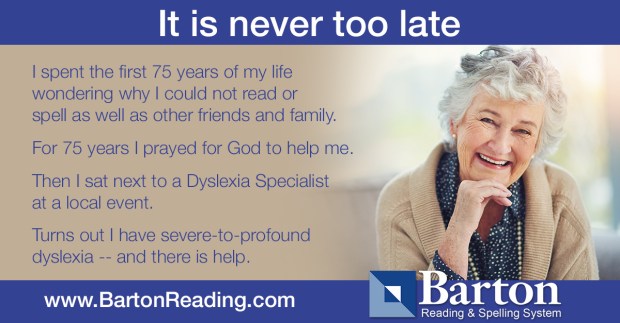
It is never too late

The following adult had received one year of Barton tutoring when she wrote this letter to Oprah (with the help of her tutor) to try to convince Oprah to do a show on dyslexia.

Dear Oprah:

I am 76 years old today.

I spent the first 75 years of my life wondering why I could not read or spell as well as other friends and family. I didn’t know why I had such a hard time finding the right word when I spoke, or why I couldn’t say the words correctly when I could retrieve them.

I didn’t know why I so often got lost in cities I had lived in for years, or why I still had to stop and think for a moment before I knew my right from my left. I didn’t know why I had such trouble memorizing things that seemed so easy for others.

Or why someone like me – someone who has started and run two businesses – could still not read well, or spell correctly enough to take a message and then be able to read it afterwards.

I didn’t know that I had severe-to-profound dyslexia.

For 75 years I prayed for God to help me. Last fall, I prayed again – that God would please, PLEASE, send me someone who could teach me how to spell.

The very next day, I ‘just so happened’ to sit next to a Dyslexia Specialist at a local event, and we ‘just so happened’ to strike up a conversation about what she does for a living. She ‘just so happened’ to tell me about the signs and symptoms of dyslexia, and I immediately recognized them in me.

Best of all, she ‘just so happened’ to tell me that there are solutions! That people who have struggled with dyslexia, for even 75 years, could still learn to read, write and spell! I made an appointment for her to test me. I cried when she told me that I had dyslexia. They were not tears of sadness, however. They were happy tears! Tears of joy! I finally had an answer!

I have been receiving the right kind of tutoring, twice a week, for a year.

I read the word authentic for the first time last month. I can now spell words that I could not even say before. I am 75 years old. Believe me – there is hope.

I have been thinking back on my 75 years. I thought of the very worst time in my life – the time when my daughter died.

Then I thought of the very best time in my life – it was the time I realized I could learn how to spell! When I finally, finally, realized what my life’s problem was. I am dyslexic.

Break the cycle

When parents see their child struggle in school the same way they did, they react with fear, panic, and guilt.

The good news is that with the right type of tutoring, the cycle of academic struggle can be broken – as this parent shared in an email to Susan Barton about a nonprofit dyslexia center in Michigan.

During a recent high school graduation ceremony, I was overwhelmed thinking back on my own graduation and the hopelessness I felt as the speaker repeatedly said this was going to be the best time of our lives.

But my ears rang with the words of a teacher, who weeks before, as she threw my final report on my desk with a big red F on it, yelled in front of the whole class, “Only stupid, ignorant, and lazy people can’t spell.”

I remember crying for the next few weeks because all of my classmates were making their big plans for the fall and the future, but I had none. They did not know that in addition to not being able to spell, I couldn’t form a sentence or construct a paragraph. (Or is it the other way around?)

The college rejection letters began coming in, one by one. With little or no direction or support from my parents and family, I was lost. I did end up attending a small local college but survived only one semester.

I blamed the school system for allowing me to fall between the cracks and go all the way through school and graduate as what I thought at the time was an illiterate.

Fast forward 30 years to the day I went to my youngest son’s kindergarten parent-teacher conference. We were heart broken when the loved and respected teacher wept as she told us that something was not right. Although she did not know what it was, she felt it might impede his learning if not identified and addressed.

That day I was hit like a freight train with my past and my own inadequacies. We wandered kind of lost for awhile, grasping at anything for answers.

After receiving the diagnosis of dyslexia, we then began the difficult task of getting help. Along the way, I found the phone number for the Binda Dyslexia Foundation and Mrs. VanZanten. After talking to her and asking questions a mile a minute, I hung up the phone and sobbed — with a hope I had not had in years. I had found the help for my son so he would not fall through the cracks as I had.

Our experience with the the Binda Dyslexia Foundation, which provides tutoring using the Barton System, has been wonderful. In just one year, our lives have changed, our son’s life has changed, and even our extended family (many of whom had such a hard time understanding dyslexia and the steps to treat it) has been impacted in a positive way.

Susan, you are invited to our son’s high school graduation in 2016. He is now full of confidence and hope for a wonderful future.