Tag Archives: Spelling

Dyslexia runs in family trees

Dyslexia is genetic. It runs in family trees. So if you see the warning signs in your child, you may also start to identify other people in your family who have it, as this parent shared. 

I just watched your on-line video which had so many “ah-ha” moments in it. You might as well have used our son’s name, Sam. Sam has every symptom you described. I feel like you know him personally, and finally, there is someone who understands him.

I have to give credit to his reading tutor, as she is the one who warned us that he “may” have dyslexia.

I now understand my mother better. She’s one of those who gets tongue tied when saying multi-syllable words, hates to write (and no one can read her handwriting), is a terrible speller, skips over the big words when reading, did not learn to talk until age 3, struggled in school – even though she is a very bright and creative person who thinks outside the box, gets lost easily, cannot remember left from right, and the list goes on and on.

Dyslexia Runs in Family Trees

And I think I have a mild case of it as well. It bothered me that I was always in the lowest reading group in my class, and that I had to re-read things 2 or 3 or 4 times to understand them.

I even took a speed reading course in high school to try to improve my ACT college prep results – because there was such a big difference between my reading test score and all of my other scores. But the speed reading course did not help my reading score at all. Now I know why.

To watch that dyslexia video, click on this link:
http://www.dys-add.com/videos/dyslexiaSymptomsSolutions_Part01.html

Poor spelling is the most obvious sign of dyslexia

I get the most heartbreaking emails from adults who are still ashamed of their spelling.

Here is what one had to do to pass her weekly spelling test:

I HATED spelling and am ashamed to admit that I even cheated on my spelling tests.

In fourth grade, my teacher would always ask the words in the same order they were in the book. So I would have a sheet of paper with the words already written out underneath my blank paper on which I “took the test.”

I would then turn in the prewritten sheet. I even purposely wrote a word wrong now and then to make it more believable.

I have never gotten over being ashamed of that.

Or this one:

If you were standing in front of me right now, I would hug you. How different my life could have been if you were around 40 years ago.

I’m 48 years old, dyslexic, and working (I should say struggling 🙂 on a Master’s degree in Communication. I am trying to create a teaching module that will incorporate dyslexia and empathy. During my research, I came across your website and just finished watching your lecture.

It was as if you had been sitting on my shoulder during my entire childhood.

I completely forgot about having my full name written on a piece of paper that my mom tucked into my sock each day — so that I could pull it out and copy it any time I had to write both of my names in elementary school.

Or this one:

I am 42 years old, and I have dyslexia and ADHD.

I have taught myself to read pretty well, but I still have a very hard time writing and spelling. It takes me hours to write a paper.

I was diagnosed in 1976 but never got the right type of tutoring. I graduated on a 3rd grade reading level, and I was in Special Ed classes for years.

Do you think I still have a chance to become a good writer with the right kind of teaching? I still have a very hard time writing and spelling. It takes me hours to write a paper.

In the time it took me to write this email, I could have written a small book. And I never send anything out without checking it many times.

If I could have overcome dyslexia when I was younger, I would have become an attorney or a legislator.

Or this one, from the president of a small company:

I am sending you this letter with spell check off just so you can see what I am deeling with. I am 44 years old I have ben diganocsed with dyslexa when I was a child I was in special classed when going through public shoole. I have allways been able to read slower of corse but I have great compratintion of what I read.

I know own my own mechanical contractiong companie and employ 25 people. I have always been embarsed about my spelling and gramer up untill about 10 years ago. Now I have my office manager proof read everything I send out and half the time I cant read what I wrought down myself. I have gotten to the point in my carrear that I am have been sucsesfull enogh that I don’t care what others think about my spelling and gramer well I guess that is not 100% true or I would not be sending you and email.

The sipelist words through me off have had there were where when I always seem to miss use them I must spell has 50% of the time hase and the same thing with had I spell hade.

It is so tyring trying to send out email that I don’t have time for my assistant the check the spelling and gramer so I send it out after reading it 5 pluss times just to see the next day when I read the email back I left out words completely. I don’t understand how I can read the same thing over and over again and not notice I lift out the or ‘s I seam to do it all the time. My spelling is so bad most of the time there is not another word close enoghf tha spell check can figure it out.

Do you think your program would haelp me deal with this issue or shoud I just have anything I right be proof read?

Yes, the Barton Reading & Spelling System will greatly improve the spelling of children, teenagers, and adults with dyslexia.

And adults with dyslexia are more ashamed of their spelling – than their slow and inaccurate reading.
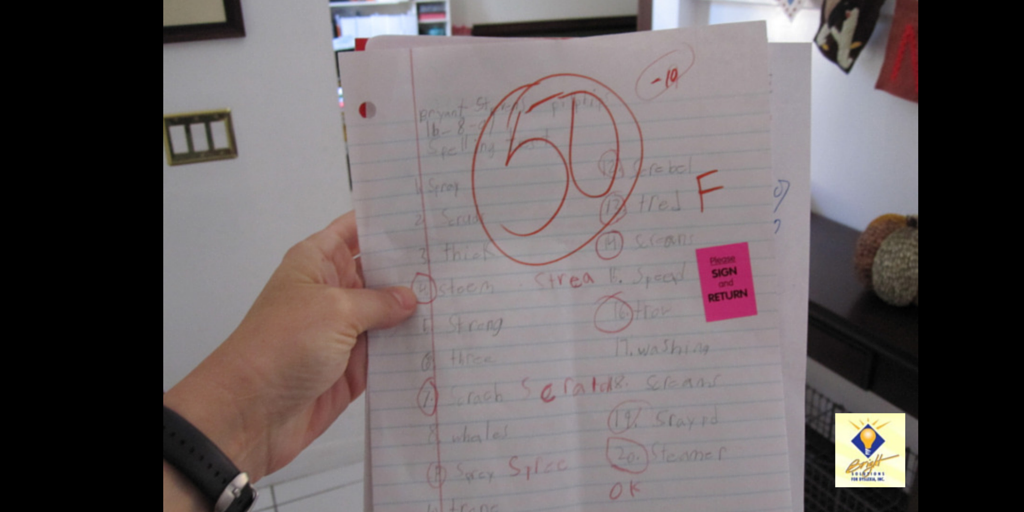
F on Spelling Test (1)

Above grade level in just 18 months

Emails like this make all of my hard work worthwhile. 

Thank you from the bottom of my heart for developing the Barton System.

My children are homeschooled. My youngest of 5 just could not learn to read no matter how hard we tried. I kept thinking we just weren’t putting in enough effort. So I told him last spring that if we tried harder, he would be reading soon. He was in 4th grade and 9 years old. Well, despite our best efforts, he still could not read.

He did not have the pressures of being in public school, and he seemed not to care that everyone else in the house could read.  But when I talked with him privately, he broke down crying and said he felt stupid. Of course, this broke my heart. A friend suggested he be tested for dyslexia.

He’s doing so much better now. He was just retested using the Peabody (PIAT). He scored at the 95th percentile for reading recognition and comprehension. His spelling was at the 53rd percentile — right where he should be for his age.

Considering he was at a preschool level just a year and a half ago, that’s a great result !!!

Your system has made my son realize how intelligent he is — despite having to learn to read in a different way. He no longer feels “less than.”

We are very open about our son’s dyslexia and encourage him to be open as well. It is amazing how many people right around me had similar struggles that I knew nothing about.

Sincerely grateful,

Janet Yates, Homeschool Parent
Winter Haven, FL

Proud Dyslexic Student

Many people who attended my Screening for Dyslexia course last week have asked for a copy of this letter. 

Dear Mrs. Barton,

My name is Nathaniel, and I have dyslexia.

This past week, my mom has been attending your Screening for Dyslexia seminar to learn more about dyslexia and how to help others. Each night when she returns to our hotel room, she shares a few highlights of her day. She told me about the emails and letters you are sharing to remind the group why they are there at your seminar.

I wanted to share one more.

My story is similar to many other people with dyslexia. My early school years were filled with much pain and emotional trauma. My first tears, and adding the word “stupid” to my vocabulary, started in Kindergarten. I was only 5 years old.

The phrases, “Try harder,” “Practice,” “Read more,” and “Why can’t you?” were engrained in my head during those early years by teachers.

I had bruises on my fingers from trying so hard to write sentences, and I was pulled out to attend a class for slow readers.

Recess was my favorite part of the school day until 3rd grade. I was punished and humiliated during 3rd grade. I was forced to sit on the wall during recess while all the other children were allowed to play . . . simply because I could not finish my work in class on time. I had to sit there watching my friends play with my incomplete piece of paper. Yet I still was not able to complete it because I could not read it.

After weeks of sitting on that brick wall, I snuck my papers home and tearfully asked my mom to help me complete them so that I could have a couple of days to play during recess. Needless to say, I never returned to that school – thank goodness!

After that, I was finally told that I had dyslexia, and I began homeschool. In fourth grade, I was reading and spelling at a very low first grade level.

But today, I am proud – MORE than proud – to share that I am just weeks away from completing Level 10 of the Barton System. Not only can I now read and spell, but I know LATIN !!!!

I just finished 8th grade at a public school where I received awards in Academic Excellence with a 3.9 GPA. I won first place in our social studies history project, and I have been accepted for high honor classes in high school next year. My test scores show that I am proficient (and even advanced) in math, comprehension, and yes, even reading !!!!

While writing is still not my strong area, mostly due to dysgraphia, my computer sure makes it look like I am a whiz. I still hate to tie my shoes, my “other right” is a common joke, and I occasionally reverse my numbers and letters when I am tired. At times, the Franklin Spelling Ace is still my best friend, and my favorite inventor is the man who created the digital clock.

Now I can spell words like “purely exhilarated” and “euphoric joy” to express my gratitude, but my word is “happy.” Those first spelling rules, like the Happy Rule, changed my tears and fears into a HAPPY, confident and successful dyslexic student.

Thank you, Mrs. Barton.

Your forever grateful and proud dyslexic student,

Nathaniel Porter
Colorado Springs, CO

Never stop doing what you’re doing

This private Facebook post from an adult shares the trauma of going through school without the right type of help — far better than I can. 

I just wanted to say thank you for all of the work you are doing for kids with dyslexia. I just finished watching Embracing Dyslexia. You were in it, and I liked what you said.

I was one of the unlucky ones. In the 80’s, they had no idea what was wrong with me. I did not hear the word dyslexia until I was in junior high. By then, I was fighting the best I could just to keep up.

My home life was not great. There was no caring or support from my parents.

Some teachers made fun of me to my face. Others called me lazy. I was accused of not trying or being stupid.

Starting in fourth grade, the school put me in special ed classes. But they put everyone with special needs in the same room. The teacher had to help one kid who was in a wheel chair, a different student who was mentally retarded, one who had behavior problems, and a small group of us in the corner who seemed to be “faking it” because we were bright and smart, but we could not figure out how to read, spell, write or do math.

We did not belong in a class with really handicapped kids. We needed help, but not the same type of help. Friends would ask, “What’s wrong with you? Why are you in the class with the handicapped kids?” I had to answer, “I don’t know.”

Needless to say, my childhood was not fun. I was beaten down mentally and physically.

Mrs. Barton, never stop doing what you are doing. Make sure no other kid has to go through what I went through.

Make sure everyone understands what dyslexia is, and how they can help kids through it.

Which is worse?

If you struggled in school, going back to college as an adult is scary. But it is even worse to watch your child or grandchild struggle in school the same way you did – as this grandmother shares.

I am 57 years old with a BSN in nursing. After 30 years of being out of school, I am applying to graduate school for a MSN in nursing. I am terrified.

My early school years were just horrible. No one knew what to do with me, so they just passed me through each year.

I had to attend summer school EVERY summer. I hated it.

I grew up thinking I was just stupid and that I must be lazy because it took so much time to read, study and retain information.

In high school, I worked so hard to get good grades. I would read a chapter (of course, that took forever), then I would go back and outline the chapter and write it down in my notebook (that also took forever), and then I would reread it every night.

I did not know that everyone did not have to do that.

I am embarrassed to tell you how long it took me to learn the alphabet or the multiplication tables.

Spell check is my godsend, but you’re right. It often does not work for me.

You’re also right about having to write a hand-written letter. It makes me sweat!

I am pretty sure my seven year old granddaughter has dyslexia. I see myself in her. She is struggling with reading in school and is starting to say that she hates school.

I will do anything to prevent her from going through the torture that I went through as a child.

Susan replied with:

If your granddaughter gets the right type of tutoring now — every day during the summer, and at least twice a week next school year – her reading will greatly improve. And her spelling and writing will also get better.

I will send you some tricks for learning math facts.

Until her skills reach grade level, her parents should provide 3 accommodations during homework time, and her teacher should provide some in class, as well.

If that happens, your granddaughter will NOT go through the same “torture” in school that you did.

Is this dyslexia?

A parent recently sent me this email: 

My daughter, Karen, is 8 years old and in third grade. She is full of life and so much fun. She makes friends easily and enjoys having a good time. But she is struggling in school.

She started struggling in Kindergarten. She had a tough time staying in her seat and was always in trouble for pestering others during nap time. She struggled with sight words and reading, and she missed the DIBELS benchmarks. But her teacher said Karen just needed to mature a little more and that she would be fine.

But in first grade, Karen was way behind in reading. She has always been a “social butterfly,” and she still had a hard time staying in her seat. So her teacher allowed her to get up move around a bit and then go back to work. That seemed to help.

Spelling tests were very tough for Karen. Reading comprehension tests were also tough because she couldn’t always read the questions. However, she could orally tell you all about the book. Her handwriting was poor, but legible.

In January, her first grade teacher suggested retention. But by the end of first grade, the teacher claimed Karen had caught up in reading. Karen was just a little immature, but she would grow out of it.

In second grade, Karen was about a semester behind in reading, and she sometimes swapped b’s for d’s. Her handwriting was (and still is) really hard to read at times. She did okay in math. But she often failed the spelling tests – even though we practiced every night and tried all sorts of things when practicing those spelling words.

This year, her third grade teacher knows all the “tricks.” Spelling tests are multiple choice. Karen has to circle the one that looks right, and she gets 95% or higher on that type of spelling test. But she cannot spell any of those words the following week.

Vocabulary tests are given with a word bank, so most weeks, Karen scores 85% or higher.

In math, she is allowed to use scratch paper and her fingers because she still has not memorized her adding and subtracting facts. Now they are starting multiplication. Yikes. Her class recently started to learn to tell time. Karen is struggling in that as well.

The school says Karen is at the 2.5 grade level in reading – but she should be at 3.4. Karen is doing better with being attentive in class, except during reading time. She loves to be read to, but she gets frustrated when she tries to read.

Her teacher doesn’t seem alarmed, but I have this feeling that something isn’t quite right.

Karen started cheering this year. She struggles to memorize the words and motions of the cheers. She often goes left when the group goes right, lifts her left hand when the group raises their right, etc.

She has a hard time memorizing Bible scriptures in her Bible classes. Scriptures that she memorized a week ago, she can no longer recite.

Do you think she might have dyslexia?

Warning signs in adults

Since dyslexia is inherited, any adult who has dyslexia should watch for it in their children.

But adults with only mild or moderate dyslexia may not know they have it because they were never tested for it. But they will recognize these classic warning signs.

Lifelong trouble with spelling is one classic warning sign, as this college graduate shared:

Before the invention of the computer and “spell check,” it would take me forever to write a paper. I NEVER wrote letters to friends.

When I asked my mother how to spell a word, she would tell me to go look it up. How the heck can you look up a word if you don’t know how to spell it? I never did understand that. But my mother was a 1952 spelling bee champion, so she had no understanding of my difficulty.

I would spend HOURS going through all of the G’s trying to find the right spelling of jaguar.

Then an English teacher in college took me aside and asked, “Alice, you can’t spell, can you?” I sheepishly admitted I could not. He then asked me how I would spell jaguar. I replied that I wasn’t sure. He asked me if I could spell cat. I said yes. He then handed me a thesaurus and told me to look up cat. And there, under cat, was jaguar.

He then told me he never again wanted me to hand in a paper that was “dumbed down” because I couldn’t spell a word. He was the one who started the ball rolling to get me tested for dyslexia. I was 20 years old and in college.

Although it took forever to write papers, even with a thesaurus, I did get a college degree.

Another classic warning sign is being a very slow reader and having to guess to figure out the longer words – as this man shared:

At 78, I still struggle with dyslexia. Growing up in Tennessee in the 30’s and 40’s, I was viewed as dumb or lazy.

I may not seem as bad as others because I learned how to cheat, and how to avoid English and other courses that required lots of reading or writing. So I made good grades in college – graduating in the top 20% of my engineering class, and then getting an MBA.

But reading is still a lot of work.

And if you are a slow reader with terrible spelling, and you are also unable to master a foreign language, the odds are pretty high that you do have dyslexia – as this woman shared:

My brother’s kindergarten teacher suspected he might have dyslexia, but it took 2 years before he was diagnosed with severe dyslexia.

When I was 12, I attended a Susan Barton presentation on dyslexia with my parents. During her lecture, I realized I was also dyslexic – but I did not struggle as much as my brother. I was just a slow reader and a terrible speller.

It was not until I had to take a foreign language class in college, and failed every language I tried, that my parents finally realized I might also have dyslexia, and had me tested.

If you know or suspect that you have dyslexia, please watch for it in your children – because it is an inherited condition. Not all of them will have it, but about half of them will.

The right type of tutoring works !!!!

Parents, if your child’s school does not provide the right type of tutoring, then you need to provide it after school.

Some parents hire a professional tutor for the reason this tutor shared:

The Barton System continues to feed my soul. I am so grateful for having this opportunity to witness firsthand how your program changes lives.

A mother was in my living room the other day listening to her son read the stories from Book 3, Lesson 1. He had gotten this far in only 8 sessions with me, yet his school had threatened to retain him in first grade.

His mother started sobbing and shared that in college, she had failed Freshman English seven  times. So she finally dropped out. “Why didn’t they have this when I was a child? I could have succeeded,” she cried.

Naturally, I started crying too.

Thank you, Susan, for changing the world!

Many parents tutor their own children using the Barton System with great success, as this mother shared:

I am replying to your email to share with you our joy.

My 10 year old son, Mike, is at the end of level three. Today I told him to read the end-of-the-lesson story aloud by himself, while I checked for your e-mail.

I quietly noticed he was applying the rules, checking for tricky letters, and moving right along – all by himself. Before he finished, he even noticed his fluent reading.

He turned to me and said, “Mom, I can read. This woman (meaning you) understands me!!!”

It was a moment I’ve been praying for. Thank you for all the hard work that you do.

But I get the biggest thrill of all when the parent gets tutoring, as this Barton tutor shared:

Jerry discovered his own dyslexia at age 50, when his son was diagnosed. Jerry shared that he could not physically keep doing logging, but he had always turned down desk jobs because they involved paperwork. He was always coming up with inventions to solve mechanical challenges, but he could not follow through and market them because of his spelling and writing challenges.

So I started tutoring him using the Barton System. He has been getting tutoring 2 to 3 times a week for about a year.

Six months ago, he was hired by a local technology company. Jerry works with the owner designing new products. He is doing well and has received several raises and promotions.

Just last week, he wrote his first letter ever – to his son Frank in boot camp. His son said he cried when he read it. He wrote back to tell his dad that he was his hero!

By the way, the Barton Reading & Spelling System is not the only system that works. For a list of other Orton-Gillingham-based systems that work, click here.
 

Tech Tools are not enough

Technology tools help adults with dyslexia survive. But as the following emails prove, they never stop wanting to improve their reading and spelling skills.

One woman wrote:

I watched your video on dyslexia, and I am exactly like your brother’s child.

I am 48. I am using Naturally Speaking software to write this. Otherwise, I would spend my entire day trying to fix my spelling mistakes.

I’m at the point where my heart is on the floor. I have tried every program in school, out of school, and on the internet.

At the moment, I’m doing a program that is supposed to increase your brain power to try please my mother for the last time.

My tears were flowing as I watched the demo of your program. Your program is the best I have seen in all my life. It makes so much sense to me.

I’m upset to realize that the form of dyslexia I have is complicated. I am also sad because I know this problem will never go away.

I don’t have to tell you the agony that a person living with dyslexia goes through. Because of that, when I was 16, I decided not to have kids. And that was a wise decision.

Things that happen in the classroom also happen at work, as this man shared:

I am 30 years old. I have always struggled with reading. I received extra help in school through Title 1 Reading, Special Ed, and summer school. As you might suspect, I hated school and would avoid going whenever possible.

Recently, I was at a seminar for my work and was asked to read out loud to the group. I was mortified.

Is there anything that would help me – an adult who has struggled for so many years – read better?

Yes. Adults with dyslexia can improve their reading and spelling at any age – so they will not have to avoid careers, as this woman did:

I am a deep thinker. I love learning about different religions and talking about God with my friends. So I would like to get a Masters degree in Theology.

But with that degree, I would end up being a teacher – which I am afraid to do because I would have to write things on the board.

I would also have to grade papers, so I would need to know more about punctuation than just a period and a comma.

And I might even have to read passages aloud to the class.

As the following man shared, companies that employ dyslexic adults are often willing to pay to improve their skills.

I am 56 years old, and I have tried a lot of things during my life to overcome dyslexia.

It started when I was in second grade. I can remember my mom crying when she tried to teach me my spelling words.

I attended summer tutoring for 4 years in a row to try to learn to read. Finally, the tutor said he would not work with me any more because it was a waste of money.

I took phonics in college, but it did not help. In fact, I failed a speech therapy class because I could not hear the sounds.

Many years later, I went to a dyslexia center. But they said they could not help me because I was too old.

Your video nailed me to a tee. When you talked about left and right confusion, that’s me. I always use spell check, and yes, sometimes it does say “no suggestions” or I pick the wrong word from the list because I can’t read them all.

I am in charge of a region with 145 centers that generate hundreds of millions of dollars in revenue. My company is trying to find something to help me. Is it too late? If not, what would you recommend?

No, it is never, ever too late to greatly improve the reading, spelling, and writing skills of adults with dyslexia. The oldest student I personally worked with was 69 years old when we started. The oldest Barton student I have met was 83.

If adults get at least 2 hours of one-on-one tutoring by someone using an Orton-Gillingham based system designed for adults, such as the Barton Reading & Spelling System or the Wilson Reading System, their skills – and their self-esteem – will get so much better.