Going to school each day is an act of courage
This is why our bright kids with dyslexia often develop anxiety or depression — and dread going to school.
Jessica Spriggs sent this to me as an email, and gave me permission to share it. She wrote:
I’m very proud of both of my kids, but only Olivia wakes up every day knowing that she will face huge hurdles throughout her school day.
Lately, it has been extremely hard to convince her that going to school is a good idea.
She sits in class feeling defeated because she learns differently than most of her classmates.
She struggles getting through homework.
And even though she studies for tests, she may barely pass a test. She knows the material inside and out, but to apply it in the traditional way seems impossible at times.
Her teachers rave about her huge vocabulary, her poise, her generosity, and her creativity.
But there is always that moment when she feels like giving up.
Maybe it’s when her name is not posted for honor roll because she just could not make A’s and B’s despite hours of studying.
Maybe it’s when she has to think about which hand is her right hand, and she gets confused.
Maybe it’s the overwhelming pressure she feels when she knows she has to take a standardized test soon — and wonders if she can pass on to the next grade.
She has lots of anxiety, but this girl has gained strength, grit, power, endurance, and most of all, a backbone to handle everything thrown her way.
She is the face of dyslexia, but she will not let it define her!
She will concentrate on the things that make her happy: being kind, sewing, artwork, and public speaking.

Slow and steady wins the race
Slow and steady wins the race — and school testing proves it.
I love getting success stories from Barton tutors — like this one.
One of my students did not talk until he was 4 years old, had speech therapy for years starting in preschool, had been in special education since Kindergarten, and was even retained once.
When I met him at the end of 8th grade, the special education teachers had just told his parents that they had tried all they could, but he was still unable to read even the most decodable first grade words.
This student is probably my most severely dyslexic student, but also the most motivated. He has worked SO hard and has even driven to my house for a lesson when school has been cancelled due to snow.
We have made slow but steady progress.
He is a senior in high school now and just finished Level 8.
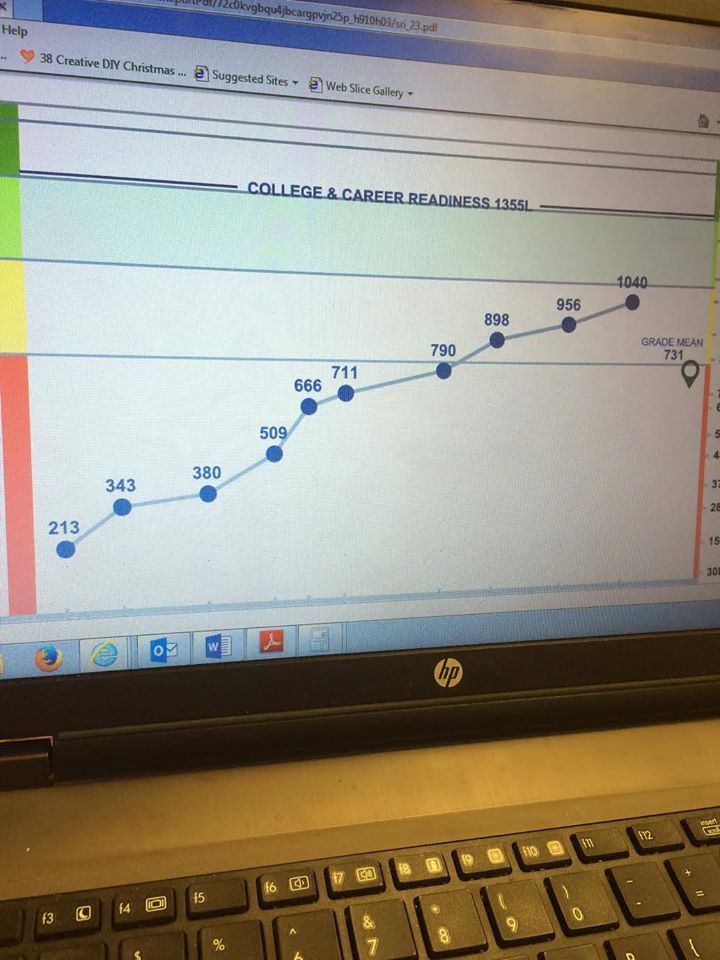
I got a text from him today that included a picture he had taken of his computer screen at school (see above) showing a graph of his progress on a school reading test – which is used to determine if a reading class is needed or not. Students need 1000 points in order to get out of the reading class and be freed up to take an elective.
His first score, 213, was from September 9, 2013. His last score, 1040, is from today, March 17, 2015.
I am just so proud of him and had to share the good news!
Karin Merkle
Certified Barton Tutor at the Advanced Level
Rapid City Dyslexia Care
Rapid City, SD
The problem with “Third Grade Guarantee” laws
Many states have recently passed, or are working on, a “Third Grade Guarantee” law, which includes mandatory retention for third graders who do NOT pass the reading portion of the end-of-year statewide exam.
Pam Collier, a parent in Ohio, gave me permission to share her email that explains why that law is as bad for students withOUT dyslexia as it is for those who do have dyslexia.
From: Pam Collier
Date: August 19, 2014
Subject: Third grade guaranteeDear Superintendent of Public Instruction at the Ohio Department of Education:
I am writing out of concern for my three children and Ohio’s Third Grade Guarantee. I have three very different children, and the guarantee will effect each of them differently.
First, I have a 10 year old daughter who is accelerated. She has tested in the gifted range on her Terra Nova, and has scored well above the cutoff of the guarantee scoring — in the Accelerated range for math and reading.
Now you are probably wondering how the guarantee could have any effects on this student. Actually, it has had a huge impact. My daughter spent her entire third grade year being “taught to the test.”
Teachers are terrified of poor test scores which negatively impact their evaluations. Instead of challenging bright young minds, the system is telling these students, “We don’t care whether you have a special gift. We just need you to do well on this test.”
My daughter was afraid of failing the test because teachers are creating so much anxiety and placing way too much pressure on our students.
Now, I have a second daughter who is a twin. She is 7 years old. Because she is a twin, I started to notice differences in her learning very early. At the age of 4, I began asking if she was dyslexic, citing she was having trouble remembering letters, numbers, rhyming, etc. I was assured that she was fine, and that her twin (my son) was just advanced.
Fast forward to kindergarten, and first grade. I asked the same questions.
In my gut, I knew I had to do something. So I pursued outside professional testing for my daughter. She was diagnosed with dyslexia, attention deficit disorder, and a visual processing disorder.
We tried getting help through the school on several occasions, and were told, “We don’t do one-on-one tutoring, we don’t have the funds for that, we don’t have anyone trained to provide the remediation your daughter needs.” So I hired an Orton Gillingham tutor who was recommended by the International Dyslexia Association.
Now, because she is not on an IEP, she is not exempt from the guarantee. Not exempt!
A child with dyslexia, a visual processing disorder, and attention deficit disorder is not exempt from retention because of a single test? A child whose parents are paying over $5,000 a year to a private tutor because her public school cannot meet her needs? A child who was not identified by the school, but was identified because her parents paid for private testing?
A child who works 5 times as hard as a student without dyslexia to learn, who is also working outside of school with a private tutor, may be retained because of a single score on a single test on a single day, in a single year?
Now, mind you, if she should fail and be retained, the state has mandated that she receive remediation “from a qualified instructor, trained in the remediation of students with a disability in reading, from a program that is approved by the state board of education.” This, from the same school system that said, “We don’t have the time, funds, or individuals with training to help your daughter.”
The same school system that told my husband and I that our goals “were too high” for our daughter. Our goals were that she meet the same benchmark as her non-disabled peers by the end of her second grade year. Our goals were too high? That is what we were told. We are being told that we should not hold our daughter by the same standards due to her disability, yet she will be held to the same standard when taking the OAA.
The Third Grade Guarantee is not serving our children’s needs. Research has shown that retention will lead to higher dropout rates. Teaching to the test is devaluing our greatest young minds. We need to have teachers who can challenge our most gifted students, and specialists who can remediate our students with learning disabilities.
We are doing the very best we can for our daughter. My husband and I are both professionals, and we know what is working for her. What recourse will we have if our bright daughter with dyslexia, a visual processing disorder, and attention deficit disorder, fails the OAA? She will get held back for what purpose? To receive the “extensive remediation” she is already receiving privately?
Why is it a mandate to retain some of our brightest individuals based on a single test?
Why are charter schools not held to the same standards?
Why do public school students have to undergo more than a dozen standardized tests, while private school students do not?
When will educators from the Ohio Department of Education realize that retention is not the answer?
Sincerely,
Pamela Collier
Retention does not work
Some states have a policy of mandatory retention for students who cannot pass the reading portion of the state standards test. But retention alone does not work – and never has, as this parent shared.
I am 34 years old, and I have struggled all my life with reading and spelling. As a result, I have this record playing over and over in my head that says I’m not smart.
My mother has a photo of me going into first grade. I did not want to go. My head is down, my arms are at my side, and my book bag is dragging along the ground. This was my theme during my entire school career. I hated school from the very beginning. I only wish someone had noticed all of the signs of my dyslexia.
Fast forward to 8th grade. I knew I was struggling – and struggling bad. I don’t recall going to classes most of 8th grade. I don’t know why I passed that grade since I didn’t attend much.
I skipped even more school during 9th grade because I was still struggling and felt stupid. I finally dropped out.
Many years later, I got my GED. I then attended a local community college. I have many credits, but not enough to get my AA. That’s because I have taken “Basic English Composition” 3 times – and dropped out 3 times. It is just too difficult for me.
At 18, I become a mother to a wonderful and incredibly smart boy named Jerry. I did not know the preschool warning signs of dyslexia.
But his kindergarten teacher informed me of his difficulty with letter recognition. Later, in first and second grade, I heard about more of his problems. He was eventually tested by the school, and he got an IEP for an Auditory Processing problem. The tests also showed he had a high IQ.
They advised that I read aloud to Jerry every day so he could hear good reading, which they claimed would teach him fluency. Despite doing that, Jerry “hit the brick wall” in 3rd grade. He was retained because he could not pass the end-of-year state standards test.
When I dropped him off at school during his second time through third grade, it was so hard for me to watch him pass all the other kids in the hallway and go back to the same wing he was in last year. I can only imagine how hard it was on him. It was a horrible year.
Fast forward. My son is now 15 years old and going into the 9th grade. Jerry continues to struggle with reading and spelling – despite getting special ed services for 6 years. He can’t even say the months of the year in order.
I watched your video on dyslexia last night and cried almost the entire way through it. You were talking about me and Jerry. I’m one of “those” kids. So is my dad, my aunt, my sister and my nephew. The inheritance pattern is so clear.
I feel very angry at the school system. I did EVERYTHING they told me to do – but none of it worked. Jerry has adapted and can get by – but even though he is smart, he feels so stupid at times – a feeling I know down to my core. It happens every time he is called on to read aloud in class, or when he can’t spell even simple words.
I am so afraid he is going to drop out – like I did.


 Bright Solutions for Dyslexia