Barton System is a Life Changer
The right type of tutoring changes everything — as this parent shares:
The Barton System changed my daughter’s life. She COULD NOT read or spell at all. She was diagnosed with dyslexia in 1st grade, and we immediately started her on this system. I purchased levels 1, 2 and 3 and tutored her myself.
It is incredibly easy to learn this system and then teach it. Susan Barton has done an exemplary job of making a product that will benefit both the student and the tutor.
My daughter finished all ten levels and is now in 9th grade. She is reading well above grade level, loves sitting in her room reading a novel, and has an A in English — for the third year in a row. She understands the rules of spelling, she knows the strategies needed to read and comprehend, and she is ever so happy.
If you are hesitating on starting your child on this system – DON’T. You will not regret it at all.
I will warn you that it is sometimes tedious and frustrating; however, it makes sense. I will not lie and say that she loved every minute of tutoring. However, she made an enormous amount of progress fairly early on, which gave her the encouragement to keep going.
I cannot emphasize enough just how wonderful this product is. Susan Barton knocked it out of the park with this one. Best purchase ever.
Donna Gisbert, parent
Lakewood, CA

Why I Homeschool
Dear Susan,
Words cannot express my gratitude for all you do for children with dyslexia.
I contacted you last fall when I was having difficulties with my two children in school. Your patience, gentleness and compassion gave me the hope that my children would be OK, and you gave me the courage to take their education into my own hands.

I read everything I could on your website, all of your links, your newsletters, and everything everyone posted. I came to realize that my children would not reach their full potential in a traditional school environment until after they completed the Barton System.
So my husband and I purchased a 20’ x 12’ shed with a loft. We turned it into a one room school house, where I spend every day educating 2 of my 4 children. We use the same curriculum that the school they previously attended uses, plus 45 minutes of individual Barton tutoring, 5 days a week.
The day we brought our children home, we made this video for our own personal benefit. I had watched and loved “Sophia’s Fight Song,” and I wanted my children to have a video like that of their own.
The progress they have made in just 7 months is truly astonishing! So today, we made a second video. If you watch them both, the progress they’ve made is undeniable.
I have NO regrets on taking your advice to do it myself at home. I have NO regrets for deciding to home school, and I have NO regrets that a 20’ x 12’ shed is sitting in my backyard instead of the built-in pool we had been saving for.
We have time again to laugh, play, and have fun! We had lost that for a little while to tears, arguments, and the frustration of (not) learning while trying to complete endless worksheets that did not make sense.
My husband and I thank you, my children thank you, and I know we are just one of many families who have been blessed by you.
Kimm Pasmore, Homeschool Parent
Spring Hill, FL
P.S. I never intended to show these videos to anyone outside of family. But so many friends have asked about my children and their progress, and I felt like they did not believe me when I told them how far my kids have come. So now I show them these two videos, and they can see it for themselves.
The importance of early intervention
If you have ever watched one of your own children struggle for years in school due to undetected dyslexia, you will step in faster when your next child starts to struggle – as this parent did.
Our story is so similar to other families I have met: the daily homework struggles, tears of frustration over a worksheet that takes other kids only a few minutes to complete, “wait and see” advice from some teachers, and “your daughter is too smart to be dyslexic” from others. I have never felt so helpless.
But when Lillian was in second grade, we were so lucky to have a teacher who pulled me aside and recommended we go outside of the school system to get a private evaluation, and lucky that the evaluator recommended the Barton Reading & Spelling System.
When we started the Barton System, Lillian was in the spring of second grade, reading at a beginning first grade level. We worked very hard to close the gap, tutoring 30 minutes every day (and increased it to an hour a day during the summer).
When Lillian took her state reading test in the spring of third grade, she scored in the “meets grade level” category – only 4 points away from “exceeds.”
Now, after her second year of tutoring, she is able to read books at her interest level, and we often catch her reading just for fun – which means more to us than any test result. The growth we have seen in her confidence and self-esteem is priceless.
I have also benefited from your program. It is so empowering to finally be able to understand how to help my kids learn to read, and to speak knowledgeably with their teachers.
But more importantly, I was able to avoid struggle and failure with my younger son Nate, who was 5 1/2 when we had his sister evaluated. Nate had almost every early warning sign for dyslexia. So I started working with him at that time (in shorter sessions), and he has learned to read solely through the Barton System. We had him privately evaluated at the beginning of his first grade year, and Nate was reading at a mid-second grade level!
Nate is a poster-child for the importance of early intervention. I recently spoke about my experience tutoring my own kids when I testified before the Oregon Senate Committee on Education in support of our dyslexia bill.
Thank you again for creating such an accessible, affordable program, and for being so helpful and available when I had questions. My kids now have a limitless future, and your program allowed me to give it to them. We are so incredibly grateful.
Theresa Sorensen
Happy Valley, OR
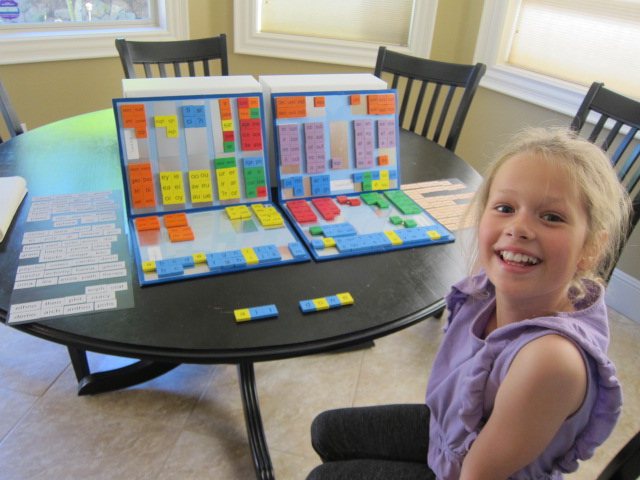
Homeschooling takes a lot of courage
It takes a lot of courage to pull your child out of public school and start homeschooling. And it requires a lot of work. But most parents of children with dyslexia will tell you that homeschooling was the best thing they ever did.
This homeschool parent’s story is so typical.
Susan, I just have to share what that my son’s (homeschool) teacher posted today. We are on Level 4 of the Barton Reading & Spelling System. He is in 4th grade.
Last year, in public school, he hit the “brick wall” and cried every day. He hated school. He hated the fact that his little sister could read better than he could. His self-esteem was nonexistent. The school refused to do ANYTHING even though we had a diagnosis of dyslexia.
So this year, in an effort to salvage whatever self-worth he had left, we decided to homeschool.
Today, I received this email from his homeschool teacher. THIS is what happens when you use EVIDENCE BASED methods that are proven to work with a dyslexic child!
Subject: Music to my ears
My son: I’m going to have to read all the way home because I want to know what is going to happen next. Can I just read it now?
Teacher: No, that’s homework.
My son: But I want to know now.
This is coming from a boy who has NEVER enjoyed reading in his life because of dyslexia and the use of ineffective reading methods in the past. Now he can’t put his book down. Proud teacher moment!
Susan, thank you for everything you do to help our kids, and to educate us and guide us in advocating for them along this rocky journey. You are an angel to many.
Cindi Bighinati
Homeschool parent in CT

The Barton System saved my daughter’s life
I love when parents take the time to send me their child’s success story, like this one:
Dear Susan,
You must get hundreds of messages like this. But I can’t wait to share that my severely dyslexic daughter, who is now in Level 9 of the Barton Reading & Spelling System, just received the Duke TIP recognition award for scoring at the 97th percentile in Language Arts on her Stanford Achievement Test.
Wow! Let that sink in for a moment….
My bottom of the curve, “you need to read to her more” child – who hated school and had to repeat second grade — now devours her school work, and scores in the “Above Average” range, not only in Language Arts, but also in Science and Social Studies.
She LOVES to read now, and she writes the most incredible stories.
When I bring up dyslexia at our parent teacher conferences, most teachers respond with wide eyes and disbelief. They can’t believe she has dyslexia because she is one of their top students.
“But it’s documented in her file. It’s severe. She has an IEP,” I remind them. Sometimes I need to pinch myself to make sure I’m not dreaming.
Last spring, she was 1 of only 7 students in the entire 4th grade who, on the last day of school, successfully passed the “4th Grade Challenge” to correctly spell and identify all 50 states on a map.
She also received an award and prize for the highest cumulative score on all of her spelling tests.
I am so lucky that her worried grandma found the Barton Reading & Spelling System online 3 years ago, and had the courage to order Level 1 and get started. By the end of my daughter’s first week of tutoring, we could tell that Barton was helping her – where everything else we had tried had failed. And she has continued to make great progress.
My daughter is so proud. She openly shares how much Barton tutoring has helped her.
I get teary-eyed just writing this email. What a difference the Barton System, carefully taught by a worried grandma, has made in my child’s life.
I can’t thank you enough.
Judy Stone-Collins, parent and now a
Certified Barton Tutor
New Orleans, LA

My Dyslexia Story
This email, which was sent to me by a homeschooling parent in Florida, touched my heart.
Our story begins when my son, Larry, was in kindergarten. He missed out on play time because he struggled to identify letters and their sounds.
In first grade, sight words caused him to miss play time.
In second grade, timed reading and math became 75% of his grade. Third grade would bring the FCAT. I was told if a student cannot read 150 words a minute, they probably would not be able to finish that test.
So we homeschooled Larry in third grade. We also asked the public school to test him. They said he had ADHD. But by then, I had been homeschooling for half a year and I felt that probably was not true. So I hired a private psychologist to test him. It turns out our son had “classic dyslexia.”
Homeschool continued through 3rd and 4th grade. Although I slowed everything down, I continued using the same curriculum – but it wasn’t working. Larry was extremely frustrated. By 5th grade, he and I were at our wits end. Shortly after starting the school year, Larry broke down and said he was stupid and wanted to kill himself. That still brings tears to my eyes.
On that very day, I knew I had to find an answer. So I got on the computer and started frantically searching for a way to teach my son. I decided to go to a message board for parents with dyslexic kids. The ONLY thing they were talking about was the Barton Reading & Spelling System – which level they were finishing, and who had the next one.
Right then and there, I googled Susan Barton. I watched your video on dyslexia that was on your website. I was overcome with emotion as I listened to you talk about your story and heard your passion for dyslexic kids. You were the first person who explained dyslexia in detail, both its weaknesses and STRENGTHS. I called Larry in to listen to part of it and I told him, “This is who you are. You are a brilliant and amazing boy to have learned as much as you have – despite the way I am teaching you.”
You promised that with the Barton System, my son would read at or above grade level and his spelling would improve, and I believed you.
Needless to say, homeschool has not been the same. Larry is now a 7th grader, is in Level 6 of the Barton System, and now believes that he can go to college and excel.
Thank you. Susan. I am forever grateful that you have become an important part of Larry’s life and education.
As this parent shared, “slower and louder” will not work for a child who has dyslexia.
To hear Susan Barton’s advice for homeschool parents who use (or are thinking about using) the Barton Reading & Spelling System, watch my free on-line presentation by clicking on the following link:
http://www.bartonreading.com/index.html#homeschool
By the way, that presentation also contains useful advice for parents thinking about homeschooling.
Why can’t people spell?
Originally posted by
The Dyslexia Project and Decoding Dyslexia – AR
When Leann sent this to me, I decided to post it. I hope someone might hold their head a little higher today, and that someone else might learn to look at the world in a different way.
Leann Hammett wrote:
From time to time, I see people post ramblings saying things like, “Why can’t people spell?” “Learn the difference between your and you’re, or between to, too and two.” These ramblings initially made me angry, but not anymore. I am here to educate you.
Have you stopped to think that if someone could spell correctly, that they would? Use spell check you say. That is easy for you, isn’t it? You see, there is a reason people don’t “just get it,” spell poorly, and don’t use correct grammar. It’s called dyslexia. For someone with dyslexia, it isn’t easy at all. Their brains are wired differently than yours.
If you read something that someone wrote with poor spelling, let it go. This person has communicated their thoughts in writing. You got the meaning. Love them for that. Accept them for that. How brave of them to put themselves out there knowing it probably isn’t spelled correctly.
If you are in a professional environment, offer to proofread and help out. Build them up. Give them confidence. And don’t complain about it. They can read what you say when you post your ramblings. Your words are hurtful. And quite frankly, make you look bad.
These people are the greatest inventors, actors, musicians, authors. (Google famous dyslexics. I dare you.) Like you, (You know, the ones who are complaining) I am left-brained. What do I have to offer? I can proofread your work and spell. Oh man, can I spell! And I LOVE grammar! It excites me!
What do they have to offer? They make the world go around. They think outside of the box. They invent, create, entertain, and run businesses. What a boring world it would be if we were all left-brained. We could sit around and proofread each other’s writing. But instead, we have brilliant people who use their magnificent brains for things that we couldn’t possibly come up with.
Instead of criticizing them, you should be thankful for them.
I am thankful for a father-in-law who is a poor speller because he can fix anything.
I am thankful for a husband who is a poor speller because he can imagine a project in the beginning phase as it will look completely finished.
I am thankful for a son who is a poor speller because he can help me hear a song made by the rain drops and who can write poetry in a snap.
I am thankful for them because they have erased my ignorance. I know how brilliant they are and that it does not matter how they spell or how slowly they read.
Spelling and grammar is NOT a sign of intelligence. But your judgment of their spelling and grammar is a sign of your ignorance.

Not eligible for special education
Many children with dyslexia will not be eligible for special education services – not even if a parent brings in a diagnostic report.
In that case, fight hard for classroom accommodations – and get the right type of help after school.
This parent did not do that – and regrets it.
Dyslexia runs in my family tree. My father, who is 60, can still remember being in second grade and having the teacher call him up to the front of the class to read out loud. The teacher would force him to stand there and “do it until you get it right” – despite him crying in front of the entire class.
I have a degree in Elementary Education, but we never had a single solitary course – not even a single lecture – on dyslexia.
Yet when my daughter struggled in kindergarten, her teacher suggested the possibility of dyslexia because:
- On DIBELS, she was not meeting benchmarks in nonsense word reading
- She had terrible spelling and could not retain her spelling words — not even the high frequency words like “some”
- She already had 2 years of speech therapy for R’s and L’s, but was not improving
- She constantly confused left and right
- And she still could not tie her shoes
At end of first grade, I asked the school to test her for a possible learning disability. The school said they wouldn’t test her until at least 3rd grade.
So during second grade, when she was not making progress in Tier 2 of RTI, I hired a highly qualified private professional to test her. She was diagnosed with moderate-to-severe dyslexia.
But when I shared that report with the school psychologist, he stated that dyslexia does not exist, that Susan Barton’s website was not a valid resource, and we could not even get a 504 Plan because he felt our daughter did not need it. He claimed she displayed no difficulties and would prove to be a good student.
Her teachers and even the principal were at that meeting, and they went along with the psychologist’s assessment – leaving us to wonder if we really knew what we were talking about.
We were so confused that we decided to follow the school’s advice — and regret it.
Our daughter is now at the end of third grade. Despite another year of phonics instruction and more RTI, she still struggles with spelling, sounding out longer words, and cannot comprehend her science textbook when she reads it herself. (But she has no trouble comprehending it when I read it TO her.)
The school did eventually test her, but her scores were not low enough to qualify for Special Ed services. And her report card grades are not too bad. She gets low B’s or C’s.
We have shown our daughter’s diagnostic report to other dyslexia professionals and organizations, and they have all agreed that she definitely does have dyslexia.
So what do I do now?

Could it be dyslexia?
One mother’s journey to help her son
by Debbie Copple
Shared with her prior written permission
“Could it be dyslexia?” I asked my son’s kindergarten teacher. “No, it’s not dyslexia. Don’t worry. He just needs to work harder,” she reassured me.
My bright boy, who had eagerly waited for the day he could go to school to learn to read, had begun to tell me that reading was stupid, and school was stupid.
“Could it be dyslexia?” I asked my son’s first grade teacher. “No, it’s not dyslexia. He just needs to work harder,” was again the response that I received.
This was after he had become so frustrated one evening that he cried, “Reading is stupid. It makes my brain hurt,” and “I am stupid.”
I sought help for my son and was told that Vision Therapy was what he needed. Over $6,000 and 1 year later, he was even further behind. “Could it be dyslexia?” I asked his Vision Therapist. “No, it’s not dyslexia. He could do better, he just chooses not to,” she told me.
In second grade, Casey attended a public school. His teacher told me that he was reading on a Kindergarten level. I was shocked. “Could it be Dyslexia?” I asked the teacher and the reading specialist. “No,” was their reply.
Meanwhile, my bright boy was struggling, his self-esteem suffering, and he had behavior problems at school. Casey was heartbroken to see the U’s on his progress reports.
“Do you test for dyslexia?” I asked a psychologist. “Yes,” he told me. While waiting for the results, I searched the internet for information about dyslexia. I found a very knowledgeable woman, Susan Barton. She told me what areas of weakness (indicators of dyslexia) I should look for in his testing report.
When the psychologist shared the results, the weaknesses – the indicators – were there. I asked if my son had dyslexia and was told, “Dyslexia cannot be tested. Dyslexia is an all-inclusive term for learning disabilities.”
I stopped asking “Could it be Dyslexia?” I knew the answer. With God as my guide, I learned to tutor my son using an Orton-Gillingham based system, the Barton Reading & Spelling System.
Casey’s grades quickly improved from U’s to A’s and B’s. His DIBELS scores improved from “High Risk” to “Above Average.” After only 4 months of tutoring, he was reading at a third grade level. Reading and spelling finally made sense.
Dyslexia is NOT determined by how great a parent you are, how much education you have, or how much money you have. Dyslexia does not discriminate.
Parents, you must listen to your gut instinct and listen to your child. Professionals can be wrong. They may have a big heart and a higher education degree, but they can still be wrong.
For professionals reading this (teachers, doctors, principals, reading specialists) my hope is that you will take the time to learn more about dyslexia, so that you too can spot the warning signs.
It is NOT my intention to discredit any of my son’s teachers, private schools, or public schools. My intention is to increase awareness. We need to do more to recognize and understand dyslexia.
Parents, if you have ever found yourself asking “Could it be Dyslexia?” the answer is “Yes, it could be.” Please do not wait another moment to get them help. It is their life, their future, their self-esteem.

Third Grade Warning Signs
Most schools do not yet test or screen for dyslexia. So parents should watch for these classic warning signs in third graders.
My son is a month into 3rd grade, and last year – somewhere in the middle of second grade, he hit a brick wall in reading.
He was always one or two levels behind his peers, and we worked very hard to stay that close to grade level. But in the middle of second grade, as other classmates reading took off, his just flattened out. He ended the year reading at level 18, and he was supposed to be at 28.
So I spent the summer at the library with him, having him read aloud to me. I also had him write 6 or 7 sentences on everything he read, and I was struck by the following:
1. He does not always see the start, middle and end of a word – especially bigger words.
2. He misreads simple words, like those for these, them for they, and who for how — and he substitutes words that mean the same thing at an alarming rate (like every other sentence).
3. He guesses at words by using pictures and a predictable story line.
4. He still confuses b and d.
5. Punctuation might as well not be on the page at all.
6. He reads very slowly, without any fluency or comprehension. It is all he can do to actually read the words and get them right, so he has no chance of understanding what he read. In fact, on his first reading comprehension test ever, he scored a 0.
7. After an entire summer of having him read aloud to me every day, and after an intense first month of school, (I mean reading so much at home that he does not have much time to do anything else), he is only reading at level 20. His peers are 32 and higher.
8. We studied for his first social studies test this past weekend. He had so much trouble memorizing the terms: region, culture, agriculture, climate, artifact, adaptation – that at first, I thought he was joking around. It was not until he began to cry that I realized how hard he was working.
I strongly suspect he has dyslexia.
I also suspect my husband has it. My husband does not read beyond a 3rd grade level, and this is forcing him to relive the hell of his school years.
I feel so stupid for not researching this sooner and for trusting his teachers and the school.
I feel like I have failed my son.

No, you have not. You can change his entire future by taking action now.
If he gets the right type of tutoring after school, plus accommodations in the classroom and during homework, you will be amazed at the improvement in his skills – and self-esteem – by the end of this school year.

 Bright Solutions for Dyslexia