Ann was “not bad enough” to qualify
When you homeschool your child, you can do Barton tutoring every day and close the gap much faster — as this parent shared:
Thank you for making a way for me to help my daughter, Ann. We just finished the entire Barton Reading & Spelling System.
When my daughter was in 5th grade, she was diagnosed with dyslexia. But she was “not bad enough” to qualify for any special help in the school. Yet she was falling further and further behind each year.
I was a stay-at-home mom, so I did not have the financial resources to hire a private tutor.
Instead, I pulled her out of her full-time public school, and found a hybrid school that has your program, The Summit Academy in Colorado. I never would have had the confidence to even try to help Ann without your “scripted” lesson plans, and her teacher, Angela Dormish, who gave Ann your posttest at the end of each level.
It took us two years, but we finished. I feel closer to Ann than I have in years.
Ann will now go back into the classroom equipped with the skills she needs.
I write this letter through grateful tears. May God richly bless you for your incredible work.
Becky Worthley
Westminster, CO

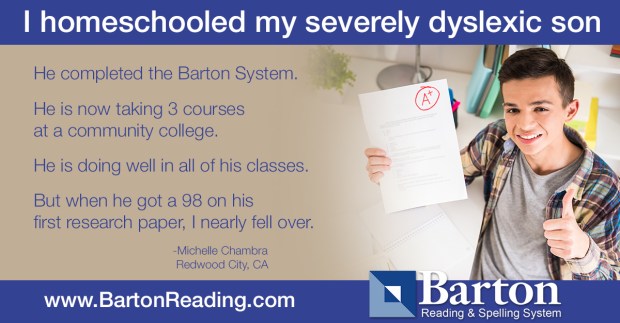
I homeschooled my severely dyslexic son
Our dyslexic kids can do well in college courses, as this parents shares:
I just had to share a success story with people who will understand what it means.
My son is severely dyslexic and was not diagnosed until he was almost 11. At that point, he could not even write simple sentences, and I was homeschooling him.
We just completed Level 10 of the Barton Reading & Spelling System in March.
David is in 9th grade and is taking three courses at the local community college as a concurrent enrollment student: World History, Biology, and Psychology. It has been a challenging semester, but the school has been wonderful about providing accommodations and most professors have been supportive.
He’s doing well in all his classes, but today was a special success. David brought home his research paper for history — the first research paper he’s ever had to write, and it required many primary and secondary sources. He earned 98/100 points!!!
I just about fell over!
I am so proud of his hard work and so thankful for the Barton System and for a school and teachers who are willing to provide needed accommodations. It just shows you what our students can do when they are given what they need.
I hope this encourages some of you who are just beginning this journey.
Michelle Chambra, former homeschool parent
now a Certified Barton Tutor
Redwood City, CA
I would never have guessed he was dyslexic
This is why Early Intervention — of the right type and intensity — is so important.
Travis never attended public school because I realized that he showed the same symptoms of dyslexia that my older son did at that age.
So I homeschooled Travis and started him on the Barton program as soon as he was old enough. I was already using it with his older brother and having good results.

Recently, Travis began expressing a desire to go to 2nd grade public school with his friends, which I figured would happen eventually. So, I took him up to our local elementary school. The teachers, principal, and counselor were great. They took him on a tour of the school, let him observe a class, and even let him play on the playground for a while. He felt right at home and decided he might like to try public school for the last six weeks of the year — even though I did explain to Travis that he would have to continue doing Barton 3x per week after school.
Of course, the first thing the school staff wanted to do was placement testing. The reading specialist evaluated his reading level as approximately 3.0 grade level. She did mention that she thought his fluency was lacking as he read from one line of text to the next and encouraged me to read aloud to him daily.
I then shared the testing we had done with a private dyslexia interventionist who said that although he was young, it was her best opinion that he was pretty severely dyslexic. I also shared some of the results of his testing, such as being at the 2nd percentile for phonemic awareness.
Then I explained how we had been using a combination of the Barton System (which she was not familiar with, but she knew of OG), and occupational therapy for the dysgraphia for almost three years. The more I talked, the wider her eyes got.
She finally said, “I had no idea that what you are saying you have done could actually be done. I see these kids come through here with such low skills, and they get further and further behind. It scars them for life, and they never recover from it. I would have never guessed that he was dyslexic. He didn’t mix up a single sound while he was reading. I’ve never known anyone who has actually fixed it.”
Mind you, we live in Texas, where dyslexic students receive “daily intervention” from our public schools. Sadly, it is often ineffective, as it was with my oldest son, who could not read CVC words in 3rd grade despite their “intervention.”
I wish I had known how to help my oldest son before he had the chance to feel like a failure, but I just didn’t know what to do.
Thank you so much for bringing awareness and education to parents about the dyslexia community, updates about the latest research of brain imaging, and best teaching practices.
Most of all, thank you for giving my son a chance to show the world what a bright boy he is. I’m still not sure if he will go to that school or if we will continue homeschooling, but I do know that either way, he will be a success because of your program and his hard work.
Alison Teal
Troy, TX
Accepting Dyslexia
I love getting emails from successful Barton students – who want to give hope and encouragement to others who are just starting this journey. Here’s one from Kate.
My name is Kate Schaefer, and I am dyslexic. I have been through the Barton System and let me tell you, it has done wonders.
I wrote this about the wonders of fighting, and eventually accepting, dyslexia. If I had read this when I was first diagnosed, it would have helped me so much emotionally along the way. Feel free to share it with anyone.
Dyslexia, defined by Webster’s dictionary, is a variable often familial learning disability involving difficulties in acquiring and processing language that is typically manifested by a lack of proficiency in reading, spelling, and writing.
This definition is undeniably verifiable and familiar to most people. However, roughly 15% of Americans have an understanding a bit beyond Webster’s description. They better comprehend, and are more comfortable with this word, because they have been at war with this genetic mutation their whole life. And I am one of the 15%.
Why did this happen? How come me and not my siblings? I don’t know. But I do know one thing. Although at times mind shatteringly challenging, it is one of the best things that has ever happened to me.
As I consider my personality, the obstacles I have had to overcome, and the immense amount of effort I have had to put forward, I know that something that has instilled this much strength, creativity, and determination in me could never be a bad thing.
Dyslexia has made me into the strong independent trooper I am today, and I hope that the other 15% of Americans see it this way as well.
My countless hours of tutoring, my recurring feeling of loss, and my constant need to put my best foot forward in order to succeed finally paid off. I went from a fourth grader unable to read the word “supply” to the winner of the Modern Woodmen Oration Contest.
I didn’t just start to succeed in academic classes, but in the Fine Arts as well. My dyslexia drove a passion for crafts, sewing, music, and decorating – like it has in many other dyslexics.
I am changed completely because of this, and I have made a decision to allow myself to fall in love with that fact.
I could be singing the same old “Why me?” song 5 years later.
But instead I am saying, “Why am I so lucky that I am a stronger, more creative woman than I would have been?”
Kate Schaefer
Going to school each day is an act of courage
This is why our bright kids with dyslexia often develop anxiety or depression — and dread going to school.
Jessica Spriggs sent this to me as an email, and gave me permission to share it. She wrote:
I’m very proud of both of my kids, but only Olivia wakes up every day knowing that she will face huge hurdles throughout her school day.
Lately, it has been extremely hard to convince her that going to school is a good idea.
She sits in class feeling defeated because she learns differently than most of her classmates.
She struggles getting through homework.
And even though she studies for tests, she may barely pass a test. She knows the material inside and out, but to apply it in the traditional way seems impossible at times.
Her teachers rave about her huge vocabulary, her poise, her generosity, and her creativity.
But there is always that moment when she feels like giving up.
Maybe it’s when her name is not posted for honor roll because she just could not make A’s and B’s despite hours of studying.
Maybe it’s when she has to think about which hand is her right hand, and she gets confused.
Maybe it’s the overwhelming pressure she feels when she knows she has to take a standardized test soon — and wonders if she can pass on to the next grade.
She has lots of anxiety, but this girl has gained strength, grit, power, endurance, and most of all, a backbone to handle everything thrown her way.
She is the face of dyslexia, but she will not let it define her!
She will concentrate on the things that make her happy: being kind, sewing, artwork, and public speaking.

Another hero
This woman is another one of my heroes.
My own dyslexia was a gift from God. Meeting you was another. Thank you for all you have done to change the lives of children and their families.
Over the past decade, I have personally witnessed the success of over one hundred students whom I have tutored using the Barton System.
One of my former students graduated valedictorian and is now in vet school.
Another took herself out of special ed classes when she was in 8th grade, and she graduated with honors last year. She actually said to me, “You saved my life.”
Another worked as a night cleaner at a fast-food restaurant until he could read all the items on the menu. He was then promoted to trainer of the night cleaners. Eventually he changed jobs to become a line cook at a fancy restaurant. This young man, who began the Barton System when he was a senior in high school, now works for a well-known soda company, is married, and has 2 children.
Yet at age 18, when we started, he said, “I will never learn how to read and write. My teachers say I have a learning disability, and that’s why I am so dumb.”
After I left the public school system, I began a ministry at my church called 3H Tutoring: Help, Hope and Honor for Struggling Readers. My pastors are very supportive and have announced this ministry to the congregation.
We now have 17 students and 3 tutors: myself and 2 trained volunteers. We have seen remarkable gains in our students’ standardized test scores, an incredible gain in their self-confidence, and a newly-found love of books and literature.
Thank you for helping me save the lives, and change the future, of these wonderful students.
TerraBeth Jochems
Founder of 3H Tutoring
Billings, MT
Start now. Don’t Wait.
I am thrilled when parents follow my advice – and then let me know, years later, what impact it had on their children, as this parent did.
Susan Barton saves lives daily. She is one of the lights in the dyslexia world because she cares, and like the dyslexic people she helps, she FINDS A WAY to get things done.
I love and respect Susan Barton for all she has done for our family. I homeschooled my gifted and profoundly dyslexic sons using the Barton Reading & Spelling System.
They are now in high school, earning college credits. One is captain of the Lacrosse team. They have started a mentoring program in their high school for kids who are dyslexic, and they are a part of a Teacher Training program at the university.
They are alive, thriving, and making an impact on the world because Susan Barton took the time to talk with me, encourage me, and provide me with the tools necessary for my children to reach their FULL potential.
Her system is solid. It is accessible to the uncertain, untrained, confused, scared parent who wants their child to soar.
START NOW. DON’T WASTE ANOTHER MINUTE !
I followed that advice from Susan Barton, and now as the founder of Decoding Dyslexia Montana, and a trained advocate, speaker, teacher trainer, and tutor, I preach the same. START NOW . . . regardless of what the school does or does not do.
Take care of your child.
Kelly Fedge-Dubose, Founder
Decoding Dyslexia Montana

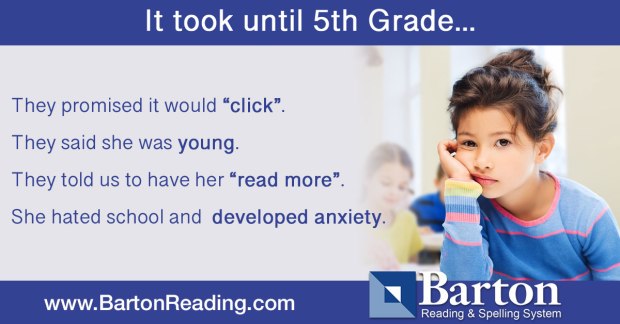
It took until 5th grade . . .
It should not take this long but sadly, it often does, as this parent shared:
We started our journey in first grade, when our daughter’s teacher shared that she was not grasping reading concepts as fast as she should. I was shocked because I had read to her since she was a baby, and books were a big part of our home.
For the rest of that school year, we spent many long, tearful evenings trying to teach her the sight words. We would go over and over and over them, but she could not retain them.
We also spent at least two hours every night doing homework, and practicing her reading.
Despite that, at the beginning of third grade, she was only reading 27 words per minute – which was at the bottom of her class.
She also struggled with spelling. I got her list several days early, so we would have extra time to learn the words. It did not help.
Over the years, the teachers said, “It will click one of these days,” or “She is young for her grade,” and “You are doing all the right things at home.” Yet year after year, she spent many long, tearful nights doing homework.
When I asked if she might have a learning disability, the answer was always, “No.”
In fifth grade, we hit a wall. That year, she spent four to five hours a week studying her spelling words – just to get a D.
She also got a D in Social Studies, even though I read the textbook out loud to her, because her vocabulary was way behind.
She began to have problems with her peers, partly due to her very low self-esteem.
At the end of some of our homework battles, she began to say she should be dead because she was useless. She stayed up late every night due to anxiety, and she developed depression. We knew we had to do something, but we did not know the cause of her academic struggles.
Then a friend at a party suggested she might have dyslexia. Our life changed that very day.
We decided to homeschool, which our daughter had been begging us to do since first grade, and we began using the Barton System as our language arts curriculum.
I have watched her grow into an amazing person.
I will never forget the day she started reading road signs out loud.
When she finished Level 6, I shared she could now start reading textbooks on her own. For her social studies assignment, there was a five page story to read, then an outline to complete, and comprehension questions to answer. She proudly completed all of it by herself. That was a HUGE self-esteem boost, and it has shown up in all areas of her life.
She now reads books for fun, and she is finally understanding how to spell words.
Homeschool is getting less time consuming as her vocabulary grows because we don’t have to explain as many words before we move forward. She is also better able to recall terms and ideas.
Only a year and a half ago, she was labeled “functionally illiterate.”
I can not thank you enough, Susan Barton, for saving my daughter and bringing my family such peace and happiness!
Please feel free to share our story to bring hope to other families who are still struggling.
Teresa Danelski
Sturgeon Lake, MN
Writing papers in college was so hard . . .
Adults who never got the right type of help in school say that writing papers in college was nearly impossible, as this person shared:
I just watched your dyslexia video, and my son has almost every single warning signs from preschool to elementary school.
I also have almost every warning sign. I always joked about being “dyslexic” growing up because I was always lost and always getting my left and right confused. But I never realized I had all of the classic signs.
I barely made it out of high school. I never wanted to go back because school was too painful !!!
I did try a semester at the local junior college, but I dropped out when the first writing assignment was given. I knew I couldn’t do it.
Years later, I took a class at a different junior college that was taught by a friend of mine. It was the most painful thing I have ever done. I did not want to disappoint my friend, so I stuck with it.
I agonized over every writing assignment. She couldn’t figure why it took me hours, and even days, to do such small writing assignments. This was before computers. I had mounds of crumpled papers, and I just about killed myself to get through that course.
I got the 2nd highest grade in the class, yet I still felt stupid because I was the only one who had to work so hard in such an easy class.
That was it. I was done with college.
I don’t want my son to go down that same path. What can I do to help him?

Never in her 13 years of teaching . . .
Teachers are amazed at how rapidly Barton students improve — even when they are tutored by a parent, as this mother shared:
Thank you so much for developing this program and your great informational videos and website. Without those, I don’t think my daughter would have been diagnosed and gotten the help she needed.
I am currently working on Level 3 with my daughter. Since starting the Barton System, she has shown tremendous progress! Her teacher told us that in her 13 years of teaching experience, she has never seen a student have this much growth in one year! She credits the program and my commitment to it.
That teacher has been wonderful. She has allowed me to come into the classroom for an hour twice a week to do Barton with my daughter.
By the way, that teacher is now interested in using the Barton System with a few other students she thinks will benefit from it. So that is super exciting!
Jennifer Veras, parent
Modesto, CA


 Bright Solutions for Dyslexia