What A Great Teacher
Susan Barton loves hearing about great teachers who go above and beyond, like this one:
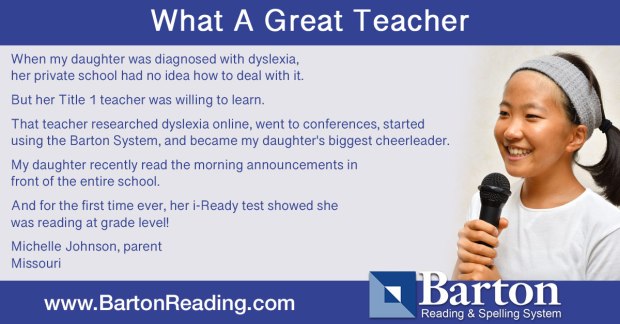
Despite paying tuition to send my daughter Ashten to a small school so she could get more one-on-one time, she still struggled.
When she was diagnosed with dyslexia, the school shared they had no idea how to deal with it. But her wonderful Title 1 teacher was willing to learn.
She started researching dyslexia, went to meetings and conferences, eventually became certified in the Barton System, and she has been one of my daughter’s biggest cheerleaders. She has even given up her own summer vacations in order to tutor Ashten year round for 2 1/2 years.
Ashten is now in 6th grade and was asked to read the morning announcements in front of her entire school. She asked a girl in 7th grade to go up with her in case she needed help with some of the words. Ashten was so excited when she shared she was able to read it all with no help. This momma was a crying mess with tears of joy for her!
She also got her i-Ready test scores back. Her Title 1 teacher let her take it entirely on her own. This is the first time EVER that she has tested out at grade level.
Her confidence has shot through the roof !
Michelle Johnson, parent
Missouri
I feel so lost and alone
Almost every parent I meet has gone through an experience like this:
Susan, I feel stuck, and I need some advice. My son is having a rough year in 5th grade. After reading some of the articles on your website, I am sure he has dyslexia.
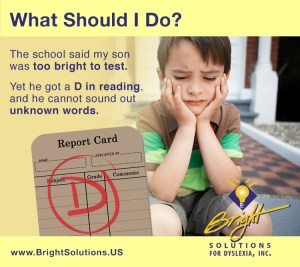
He struggled so much in first grade that his teacher thought he had a Learning Disability. But the school said he was too young to test.
Over the years, he has made some improvement because he works hard, is a pleaser, and most of his teachers love him. In fact, he got straight A’s in 4th grade — with TONS of hard work.
But this year, he has had a one-two punch: a teacher who is not so great, plus he is hitting the “read-to-learn” wall.
I am getting nowhere with the school. They claim he tests “on level,” yet he got a D in Reading on his report card – which seems to alarm no one. When I went to his teacher with my suspicions of dyslexia, she said that in her 23 years of teaching, she had only known 1 kid with dyslexia.
The Principal (who has a background in Special Ed) said my son might have some decoding issues. So he set up a Child Study Team meeting. But t he team said he was too bright to need help.
I tried to tell them that my 5th grade son just now, finally, learned to tie his shoes (using his own wacky, two-loop method), he cannot name the months in order, and he cannot play a game like Apples to Apples where he has to sound out a word in isolation. So they had the reading specialist assess him. She indeed found some “decoding” issues. She sent home a first grade chunk-matching game. That’s it. I am dumbfounded.
I feel lost and alone with no way to help my son. I live in a town with TWO teaching universities, yet I cannot find anyone who tests for dyslexia, or any professional tutors who are certified in one of the good Orton-Gillingham based programs.
How do I advocate for my child in a school system that deems him too bright?
Since dyslexia affects 1 in 5 kids, I can’t be the only parent feeling so helpless – and so worried about middle school.
Even teachers are frustrated
Once teachers or reading specialists learn about dyslexia, they start to realize how many of their struggling students have it. But when they try to share that with their fellow teachers or administrators, they often run into roadblocks – as this teacher shared.
Hi Susan,
I am a reading specialist at a public school in New York. We spoke briefly by phone a few months ago because I was concerned about my 4th and 5th grade students who are not making much progress.
I watched your videos, visited several websites, and read Sally Shaywitz’s book, Overcoming Dyslexia. I am convinced they have dyslexia.
But after I shared my concern with my principal and the other teachers, things at school have become a nightmare. I have been accused of making the teachers feel inferior when I share that many students need a different type of reading instruction. They claim to have years of teaching experience, and they know what they’re doing. Yet many of these students will be passed on to middle school still reading at a second grade level.
When I talk to the resource room teacher about dyslexia, he looks at me as if I have 3 heads.
I am no longer invited to student support meetings or IEP meetings.
I don’t know how to continue in the uphill battle. I know this is a lot to throw at you, but I really don’t know who else to turn to. I have sent my principal links to your videos, and I have summarized the findings of Overcoming Dyslexia. But everyone seems indifferent, and I am now perceived as a villain.
I know my students need more support. It hurts so much to see them suffer. I am committed to helping them reach their potential. But I feel so deflated and so stuck.
I need a plan for how to continue to advocate for them. I’d appreciate hearing your thoughts.
The problem with RTI
Many children with dyslexia will not qualify for special education services during their early school years. But these days, they almost always get put into Tier 2 or Tier 3 of RTI.
One problem with RTI is how they measure “improvement,” as this mother shares:
I am the mother of an 9 year old boy. I want him tested for dyslexia. But the school says they don’t do dyslexia testing.
Instead, they gave him a test to determine if he needed special education services. But he passed the assessments and the IQ part, so they dropped it. They concluded he was just immature for his age and recommended retaining him, which we did.
Yet he still reads below grade level. At the beginning of his second time through 2nd grade, he was reading at a beginning first grade level. We are now at the end of the year, and his reading has only improve by 3 months — to a middle of first grade level.
To me, he should have improved more, given that he has had an entire extra year of PALS plus Tier 2 of RTI. Yet the school claims because he improved, he will not continue to get RTI next year.
Parents, never accept “some” improvement as good enough. If your child is not making more than one year of gain in one year of intervention, the gap is not closing. It’s getting bigger.
Another problem with RTI is that the right intervention is stopped too soon — before a student has finished the intervention program, as happened to this student:
I have been concerned about my son since kindergarten, and I have fought every year to have the school test him for a possible learning disability or dyslexia.
The school finally tested him in second grade, and although it showed some struggles, they said his scores were not bad enough to classify him as having a learning disability. Yet he struggled significantly with reading (he could not sound out any real or nonsense words — and messed up the vowels), read very slowly, and had terrible spelling.
His handwriting was so poor that I hired a private OT to work with him during third grade.
In fourth grade, he was put into Tier 2 of their RTI program. He began to get small group instruction using the Wilson Reading System, which is when he finally began to enjoy reading. Yet at the end of the year, because he had improved, he no longer qualified for RTI.
Our son is now 11 and in the middle of 6th grade at a junior high school. Although he will read if we push him hard, he refuses to read out loud any more (and he does have to read a passage several times before he comprehends it), his spelling continues to be horrible (even the simple high frequency words), and he struggles in math because he still does not know his multiplication tables.
Despite that, believe it or not, he has mostly B’s and A’s on his report card.
Yet he now resists all attempts to help him, and he has emotionally shut down.
We fear that as the demands of school increase, he will not be able to survive the challenges.
Parents, if you know or suspect your child has dyslexia but their school is not (or is no longer) providing the right type of intervention, then get it for them after school . . . by either hiring a tutor who uses an Orton-Gillingham based system or by getting the Barton Reading & Spelling System and tutoring your own child.
Connect The Dots
Can you connect the dots . . . and see the cause and effect this has on our children?
First I received this email from a reading specialist:
In December I will graduate with a Masters of Education in Literacy and a reading specialist endorsement. Despite an otherwise excellent program, guess what I have not learned… how to teach students who struggle to learn to read.
But I have a dyslexic son, so I know the programs exist. Question is, will I be allowed to use them and actually help struggling students?
Then I received this email from a parent:
My son started struggling in reading in kindergarten. He worked with a Reading Specialist at school who used Reading Recovery with little or no lasting success.
He was promoted to first grade but was put in Tier 2 of RTI (Response to Intervention) at the beginning of first grade. We also hired a private tutor to work with him after school.
That is in addition to spending up to 3 hours a night on homework. He is the hardest working kid you will ever meet. He never gives up — despite only passing 2 spelling tests in his entire life.
He was diagnosed with dyslexia during the summer after first grade. I then did a foolish thing. I presented the results to the school and assumed they would take over from there and provide him with the right type of help.
But he is now in third grade, and despite having a 504 Plan in place, he is still reading at a first grade level (even after spending last summer going to a Sylvan center). Yet he is very bright. He gets an A in science and social studies because the tests are read to him.
My son is getting frustrated, and he is tired of reading the “babyish” books.
The teachers in our schools need to be educated on how to teach dyslexic children to read — and so do I.

 Bright Solutions for Dyslexia