Before And After Barton
Susan Barton loves hearing from parents about the impact Barton tutoring had on their child, as this parent recently shared:
Before Barton, my daughter Ella could not read, yet she loved books. She could not spell, yet she was creative and made up wonderful stories.
Her peers could read with ease. Ella really wanted to learn. But even in a private school with one-on-one reading classes, Ella could not read at all.
Then we found the Barton System and her life changed.

She applied to 10 colleges for Fall 2021 and was accepted to all of them. She was even offered the maximum amount of Merit Scholarship that the colleges award.
Best of all, for the last two years, Ella has been tutoring the Barton System for free to students whose families could not afford tutoring. The students absolutely love her.
The Barton System has been quite a gift to Ella.
Brook Euler
Parent and Certified Barton Tutor
Wellsville, PA
Nothing Had Worked
Susan loves getting emails from parents, like this one:
When I first contacted you, we had already tried Orton Gillingham, Lindamood-Bell, a private school for dyslexic students for 2 years, vision therapy, tutoring at a Score center, and the Sound Reading program. Nothing had worked.
Truly I was at a loss when I turned to you. Thank you for the Barton System. It is the ONLY program that worked for my son. He loves his Barton tutoring sessions, and he now feels confident, creative, and gifted.
Sky has finished Level 9 of the Barton System and is doing so well in school.
He did concurrent high school and college enrollment. After the first month, he stopped using all of his accommodations (textbooks on audio, recording of lectures, and extra time on tests). He got all A’s and B’s on his college assignments, and A’s on his final exams.
He just graduated high school, in 6 months he will complete his Auto Tech Certification, and then he will continue on for a college degree in Automotive Engineering and Design.
The Barton System is fabulous, concise, flows and builds on itself, and most importantly, it works.
Thank you for creating this system and being an advocate for dyslexia.
Meri Seibert, parent
Los Angeles, CA

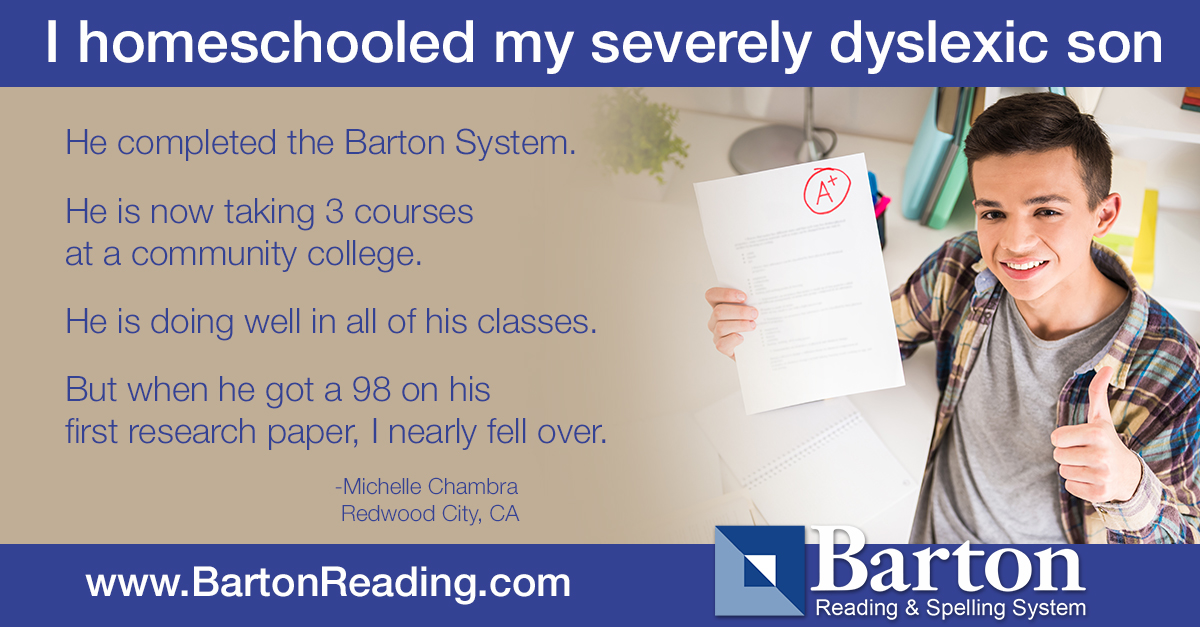
I homeschooled my severely dyslexic son
Our dyslexic kids can do well in college courses, as this parents shares:
I just had to share a success story with people who will understand what it means.
My son is severely dyslexic and was not diagnosed until he was almost 11. At that point, he could not even write simple sentences, and I was homeschooling him.
We just completed Level 10 of the Barton Reading & Spelling System in March.
David is in 9th grade and is taking three courses at the local community college as a concurrent enrollment student: World History, Biology, and Psychology. It has been a challenging semester, but the school has been wonderful about providing accommodations and most professors have been supportive.
He’s doing well in all his classes, but today was a special success. David brought home his research paper for history — the first research paper he’s ever had to write, and it required many primary and secondary sources. He earned 98/100 points!!!
I just about fell over!
I am so proud of his hard work and so thankful for the Barton System and for a school and teachers who are willing to provide needed accommodations. It just shows you what our students can do when they are given what they need.
I hope this encourages some of you who are just beginning this journey.
Michelle Chambra, former homeschool parent
now a Certified Barton Tutor
Redwood City, CA
Writing papers in college was so hard . . .
Adults who never got the right type of help in school say that writing papers in college was nearly impossible, as this person shared:
I just watched your dyslexia video, and my son has almost every single warning signs from preschool to elementary school.
I also have almost every warning sign. I always joked about being “dyslexic” growing up because I was always lost and always getting my left and right confused. But I never realized I had all of the classic signs.
I barely made it out of high school. I never wanted to go back because school was too painful !!!
I did try a semester at the local junior college, but I dropped out when the first writing assignment was given. I knew I couldn’t do it.
Years later, I took a class at a different junior college that was taught by a friend of mine. It was the most painful thing I have ever done. I did not want to disappoint my friend, so I stuck with it.
I agonized over every writing assignment. She couldn’t figure why it took me hours, and even days, to do such small writing assignments. This was before computers. I had mounds of crumpled papers, and I just about killed myself to get through that course.
I got the 2nd highest grade in the class, yet I still felt stupid because I was the only one who had to work so hard in such an easy class.
That was it. I was done with college.
I don’t want my son to go down that same path. What can I do to help him?

Sports
I get emails like this all the time, and they always bring me to tears.
When I heard you speak on Thursday, I cried. I wish I had that information when we began our journey.
My 17 year old son, David, is dyslexic. He was diagnosed when he was 8, and he has had lots of tutoring at Sylvan and from retired Reading Specialists over the years, which has helped a little bit.
David is a really smart, handsome, and well-liked young man. He hides his dyslexia well. Yet it is still there. After your presentation, I asked him, “What letter comes after S?” He quickly responded, “R.” I shared that was “before,” not after. He then said, “I know what you’re doing. Don’t even ask me about the months of the year.”
When he played PeeWee football, he always wore a wristband so he could tell left from right.
David recently gave directions to our house to his new girlfriend. But he frequently told her to turn left instead of right. After 45 frustrating minutes, he finally handed me the phone and begged, “Please get her here.”
He is a gifted athlete and would like to play football in college. But his grade point average is only 2.65 due to his failing French (a D) and algebra (also a D). He must also pass the ACT (college entrance exam). We paid for an ACT prep course, but after the course, he only scored 13. He needs at least a 17.
He needs extra time on the reading portion, and he dreads math. He was so nervous because he knew he was not going to have enough time to finish the test. How do I go about getting him more time on the ACT?
He feels he is not smart enough to make it in college. The many days of sitting in the hall, being put in “the dumb class” (as he called it), and being teased by his peers does not go away.
But I want him to be able to follow his dream. I do not want him to join the military, which is his backup plan.
Which is worse?
If you struggled in school, going back to college as an adult is scary. But it is even worse to watch your child or grandchild struggle in school the same way you did – as this grandmother shares.
I am 57 years old with a BSN in nursing. After 30 years of being out of school, I am applying to graduate school for a MSN in nursing. I am terrified.
My early school years were just horrible. No one knew what to do with me, so they just passed me through each year.
I had to attend summer school EVERY summer. I hated it.
I grew up thinking I was just stupid and that I must be lazy because it took so much time to read, study and retain information.
In high school, I worked so hard to get good grades. I would read a chapter (of course, that took forever), then I would go back and outline the chapter and write it down in my notebook (that also took forever), and then I would reread it every night.
I did not know that everyone did not have to do that.
I am embarrassed to tell you how long it took me to learn the alphabet or the multiplication tables.
Spell check is my godsend, but you’re right. It often does not work for me.
You’re also right about having to write a hand-written letter. It makes me sweat!
I am pretty sure my seven year old granddaughter has dyslexia. I see myself in her. She is struggling with reading in school and is starting to say that she hates school.
I will do anything to prevent her from going through the torture that I went through as a child.
Susan replied with:
If your granddaughter gets the right type of tutoring now — every day during the summer, and at least twice a week next school year – her reading will greatly improve. And her spelling and writing will also get better.
I will send you some tricks for learning math facts.
Until her skills reach grade level, her parents should provide 3 accommodations during homework time, and her teacher should provide some in class, as well.
If that happens, your granddaughter will NOT go through the same “torture” in school that you did.
Warning signs in adults
Since dyslexia is inherited, any adult who has dyslexia should watch for it in their children.
But adults with only mild or moderate dyslexia may not know they have it because they were never tested for it. But they will recognize these classic warning signs.
Lifelong trouble with spelling is one classic warning sign, as this college graduate shared:
Before the invention of the computer and “spell check,” it would take me forever to write a paper. I NEVER wrote letters to friends.
When I asked my mother how to spell a word, she would tell me to go look it up. How the heck can you look up a word if you don’t know how to spell it? I never did understand that. But my mother was a 1952 spelling bee champion, so she had no understanding of my difficulty.
I would spend HOURS going through all of the G’s trying to find the right spelling of jaguar.
Then an English teacher in college took me aside and asked, “Alice, you can’t spell, can you?” I sheepishly admitted I could not. He then asked me how I would spell jaguar. I replied that I wasn’t sure. He asked me if I could spell cat. I said yes. He then handed me a thesaurus and told me to look up cat. And there, under cat, was jaguar.
He then told me he never again wanted me to hand in a paper that was “dumbed down” because I couldn’t spell a word. He was the one who started the ball rolling to get me tested for dyslexia. I was 20 years old and in college.
Although it took forever to write papers, even with a thesaurus, I did get a college degree.
Another classic warning sign is being a very slow reader and having to guess to figure out the longer words – as this man shared:
At 78, I still struggle with dyslexia. Growing up in Tennessee in the 30’s and 40’s, I was viewed as dumb or lazy.
I may not seem as bad as others because I learned how to cheat, and how to avoid English and other courses that required lots of reading or writing. So I made good grades in college – graduating in the top 20% of my engineering class, and then getting an MBA.
But reading is still a lot of work.
And if you are a slow reader with terrible spelling, and you are also unable to master a foreign language, the odds are pretty high that you do have dyslexia – as this woman shared:
My brother’s kindergarten teacher suspected he might have dyslexia, but it took 2 years before he was diagnosed with severe dyslexia.
When I was 12, I attended a Susan Barton presentation on dyslexia with my parents. During her lecture, I realized I was also dyslexic – but I did not struggle as much as my brother. I was just a slow reader and a terrible speller.
It was not until I had to take a foreign language class in college, and failed every language I tried, that my parents finally realized I might also have dyslexia, and had me tested.
If you know or suspect that you have dyslexia, please watch for it in your children – because it is an inherited condition. Not all of them will have it, but about half of them will.

 Bright Solutions for Dyslexia