I Can and I Will
Susan Barton loves getting letters from graduates of the Barton Reading & Spelling System who then start sharing their story in an effort to change things for other students with dyslexia. Here’s Katherine’s story:
I can and I will. Just watch me.
For years this has been my go-to statement.
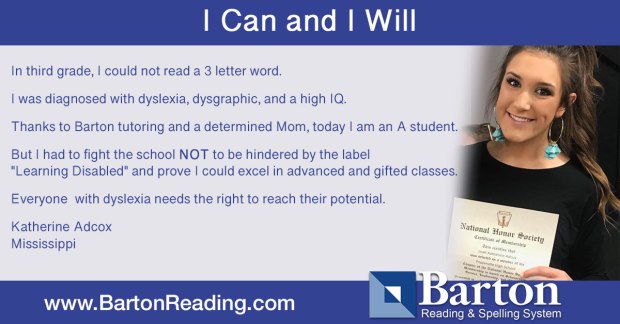
You see, in the third grade, I was diagnosed “twice exceptional” having both dyslexia and dysgraphia paired with a high IQ. Up until that point, I couldn’t read a three-letter word. My parents had meeting after meeting with my teachers and were told that I was an underachiever and that I would never be more than a mediocre student. Well, lucky for me, they knew better!
But for most children who suffer from hidden disabilities, there isn’t anyone there to advocate for them. This creates a huge crack for these kids to fall through and most of the time leads to these children becoming statistics. Over forty million Americans have dyslexia and only slightly more than two million are receiving services for their diagnosis.
So many children fall behind in school and ultimately drop out due to the lack of in-depth screening to be able to identify certain markers that could provide early intervention. Had my mother not known that something wasn’t adding up and decided to seek second and third opinions, I have no doubt that I would have been a statistic.
Today I am an all A student and have earned admission into the BETA Club, National Honor Society, and didn’t do too terrible on my first time taking the ACT! Because someone cared enough to advocate for me, I was able to return to school after my diagnosis and not only receive the proper training for my dyslexia, but I was also immediately entered into the gifted class! You cannot imagine what this did for my self-esteem! I was pulled twice a day, once for therapy and once for gifted!
Again, this was because someone believed I could do it! Someone had the insight to know that helping me advance what my brain was good at, as they helped me learn to overcome what my brain wasn’t good at, was going to be the key to my success!
My journey hasn’t always been an easy one and to this day I continue to fight the fight! I want to take this a step further and make sure that once students are diagnosed, they are not hindered by the label.
I have had to fight my way through class scheduling because they didn’t think I could handle certain classes. I had to beg to be put into chemistry in my 10th grade year and promise to give 100% effort. I finished that class with a high A. Had I not pushed for this, I would have never gotten the opportunity to learn in advanced classroom settings, simply because I have been labeled “learning disabled”.
I always have to prove that I can excel greatly if I’m not put into a box and labeled! I believe that once identified, dyslexia becomes a gift instead of a disability! With proper accommodations students can finally realize their potential and begin to focus on the many positive traits that come along with this diagnosis.
I once read a quote saying, “everyone is a genius, but if you judge a fish by his ability to climb a tree, he will live his whole life believing he’s stupid!” There are seven different types of learners in a classroom: auditory, visual, verbal, logical, physical, social and solitary. Since that’s the case, doesn’t it make sense that there are that many different types of testers? Standardized testing is merely taking a fish and asking him to climb that tree!
I am trying to help bring awareness to this issue by being a student liaison to the Mississippi Department of Education. I am currently a member of the Mississippi State Superintendent’s Student Advisory Council, serving a two-year term. This role lets me tell my story and offer insight to what I believe will help to identify struggling students, hopefully helping to ultimately lower the dropout rate.
Statistics show that sixty-two percent of non-readers become high school dropouts. I think this is unacceptable and can certainly be helped. I cringe to think of where I might be today, had someone not seen my potential.
I hope my story can be eye opening!
What if you have a student who has the potential to be President of the United States, or a brain surgeon, or cure cancer, but never makes it out of high school because his or her potential was never realized. The accommodations not put into place to see that just because he can’t climb the tree doesn’t mean he can’t swim the ocean!
So many children are out there struggling daily who don’t know their own potential! So many educators and adults who don’t know what they are looking for write us off as underachievers. This has to stop!
I want to ultimately rebrand dyslexia and make the world see who we really are! We are the imaginers, the creators! We are driven and ambitious and persistent — IF we aren’t made to believe we are simply mediocre!
How can we help? Let’s start a discussion!
Katherine Adcox
Mississippi
Miracle In A Box
Grandmothers often tutor a grandchild who has dyslexia with great results — as this grandmother shared:
The Barton Reading System is outstanding due to its systematic introduction of new sounds and skills.
The videos are well done, and between that and the excellent teaching manuals, anyone can use this system with success.
And I can’t say enough about your free support and the many free goodies on your tutor support website.
My severely dyslexic grandson went from not being able to read the word “cat” in 3rd grade to handling 7th grade quite confidently.
You have created a miracle in a box!
Patty Drake, grandmother and tutor
Medford, OR

Regained his self-confidence
I love getting emails like this:
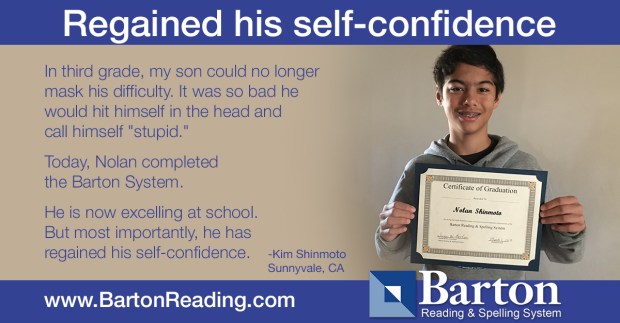
Five years ago, my son was struggling terribly. He was in third grade and could no longer mask the difficulty he was having with reading fluency.
Homework drove him to tears. It had gotten so bad that he would hit himself in the head and call himself “stupid.” It broke my heart.
Today, Nolan completed the Barton Reading & Spelling System with Janis Garcia, a wonderful Certified Barton Tutor. He proudly received his certificate signed by Susan Barton.
Nolan is excelling in school, but perhaps more importantly, he has regained his self-confidence.
I can’t thank you enough for all you have done to drive awareness, to advocate, and to provide resources for addressing the needs of children with dyslexia. It has made all the difference in the world for our family.
Kim Shinmoto, parent
Sunnyvale, CA
Light at the end of the tunnel
When you are going through the long process of tutoring, it can be hard to see the light at the end of the tunnel. So I wanted to share this message that was posted on a Facebook page for parents of children with dyslexia. This parent gave me permission to share her post.
A message of hope for all struggling students and parents:
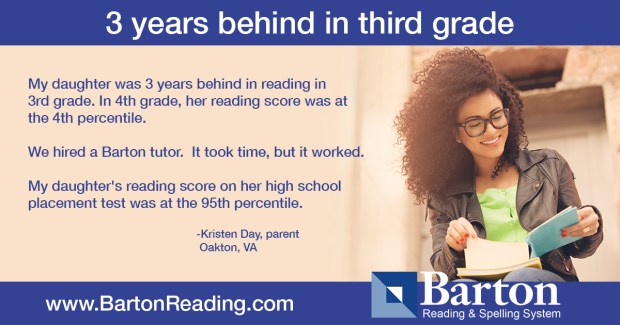
My daughter was 3 years behind in reading in 3rd grade.
At the beginning of 4th grade, testing showed she was only reading at the 4th percentile.
So we found a tutor, and over the next 3 years, my daughter went through the Barton Reading & Spelling System at her pace, and she learned to read.
The Barton System claims to be able to bring dyslexic children up to a 9th-grade reading level, and boy, did it deliver.
I just received my daughters results from the high school placement test where she scored … drum roll please … 95th percentile. That means she scored higher than 95 percent her peers.
She has gone from hating to read to reading a book a week. It has been quite an amazing transformation.
Thank you Susan Barton, my wonderful Barton tutor, and my amazing hard-working daughter who never gives up. Tears of joy flow freely.
Kristen Day, parent
Oakton, VA
A Third Grade Teacher’s Point of View
By Sally Miles
Shared with prior written permission
As a teacher, dyslexia therapist (ALTA), mother and grandmother of two brilliant dyslexics, and someone who loves learning, I do my best every day to meet the needs of my students in my 3rd grade class. I fail every day, but we forgive and move on.

I do my best to address teaching in an Orton-Gillingham based manner for every subject. Not every student I have is dyslexic, but every child can benefit.
My students have so many needs that even though I truly put forth the effort, my brain and my heart cannot possibly think of everything that every child needs during every moment of every day. Among the children I greet every morning are those diagnosed and undiagnosed dyslexic children, a hearing impaired child with cerebral palsy, diagnosed and undiagnosed children with ADHD, auditory processing disorders, language disorders and autism, English as a second language, children who go to bed unfed since they left school, children who are abused, and children who are neglected.
Even though I try to meet every single need of your child, I’m going to fail. So before you call me out on Facebook, talk to me! Tell me, in a kind way, what your child needs that I am not doing.
Remember, the things your child needs that I’m trying to do . . . may be met with resistance by other parents because I teach in a way that is different, or their child may have very different needs.
Remember that I am human and may forget simply because I have so many different needs swirling through my head.
Remember that my goal is to teach all of your children, every day, with the “right” way for your child, and I will fail. I will get up again the next day and try to do better.
But it is easier if you tell me what your child needs . . . rather than think I’m too ignorant, I don’t care, I’m lazy, or I’m just another part of an often-broken system.
The problem with “Third Grade Guarantee” laws
Many states have recently passed, or are working on, a “Third Grade Guarantee” law, which includes mandatory retention for third graders who do NOT pass the reading portion of the end-of-year statewide exam.
Pam Collier, a parent in Ohio, gave me permission to share her email that explains why that law is as bad for students withOUT dyslexia as it is for those who do have dyslexia.
From: Pam Collier
Date: August 19, 2014
Subject: Third grade guaranteeDear Superintendent of Public Instruction at the Ohio Department of Education:
I am writing out of concern for my three children and Ohio’s Third Grade Guarantee. I have three very different children, and the guarantee will effect each of them differently.
First, I have a 10 year old daughter who is accelerated. She has tested in the gifted range on her Terra Nova, and has scored well above the cutoff of the guarantee scoring — in the Accelerated range for math and reading.
Now you are probably wondering how the guarantee could have any effects on this student. Actually, it has had a huge impact. My daughter spent her entire third grade year being “taught to the test.”
Teachers are terrified of poor test scores which negatively impact their evaluations. Instead of challenging bright young minds, the system is telling these students, “We don’t care whether you have a special gift. We just need you to do well on this test.”
My daughter was afraid of failing the test because teachers are creating so much anxiety and placing way too much pressure on our students.
Now, I have a second daughter who is a twin. She is 7 years old. Because she is a twin, I started to notice differences in her learning very early. At the age of 4, I began asking if she was dyslexic, citing she was having trouble remembering letters, numbers, rhyming, etc. I was assured that she was fine, and that her twin (my son) was just advanced.
Fast forward to kindergarten, and first grade. I asked the same questions.
In my gut, I knew I had to do something. So I pursued outside professional testing for my daughter. She was diagnosed with dyslexia, attention deficit disorder, and a visual processing disorder.
We tried getting help through the school on several occasions, and were told, “We don’t do one-on-one tutoring, we don’t have the funds for that, we don’t have anyone trained to provide the remediation your daughter needs.” So I hired an Orton Gillingham tutor who was recommended by the International Dyslexia Association.
Now, because she is not on an IEP, she is not exempt from the guarantee. Not exempt!
A child with dyslexia, a visual processing disorder, and attention deficit disorder is not exempt from retention because of a single test? A child whose parents are paying over $5,000 a year to a private tutor because her public school cannot meet her needs? A child who was not identified by the school, but was identified because her parents paid for private testing?
A child who works 5 times as hard as a student without dyslexia to learn, who is also working outside of school with a private tutor, may be retained because of a single score on a single test on a single day, in a single year?
Now, mind you, if she should fail and be retained, the state has mandated that she receive remediation “from a qualified instructor, trained in the remediation of students with a disability in reading, from a program that is approved by the state board of education.” This, from the same school system that said, “We don’t have the time, funds, or individuals with training to help your daughter.”
The same school system that told my husband and I that our goals “were too high” for our daughter. Our goals were that she meet the same benchmark as her non-disabled peers by the end of her second grade year. Our goals were too high? That is what we were told. We are being told that we should not hold our daughter by the same standards due to her disability, yet she will be held to the same standard when taking the OAA.
The Third Grade Guarantee is not serving our children’s needs. Research has shown that retention will lead to higher dropout rates. Teaching to the test is devaluing our greatest young minds. We need to have teachers who can challenge our most gifted students, and specialists who can remediate our students with learning disabilities.
We are doing the very best we can for our daughter. My husband and I are both professionals, and we know what is working for her. What recourse will we have if our bright daughter with dyslexia, a visual processing disorder, and attention deficit disorder, fails the OAA? She will get held back for what purpose? To receive the “extensive remediation” she is already receiving privately?
Why is it a mandate to retain some of our brightest individuals based on a single test?
Why are charter schools not held to the same standards?
Why do public school students have to undergo more than a dozen standardized tests, while private school students do not?
When will educators from the Ohio Department of Education realize that retention is not the answer?
Sincerely,
Pamela Collier

 Bright Solutions for Dyslexia