They all read now
Notes like this is what keeps me energized and willing to work so hard:
Susan, I just wanted to thank you for all your help over the years. I have called you several times for advice, and you even reviewed our neuropsychologist’s report on our kids, Michael (9th grade), Patrick (8th grade), and Nicholas (6th grade).
All of them are severely to profoundly dyslexic. I never thought they would read, and even half way into Level 3 of the Barton System, I didn’t think they would ever read for pleasure.
But they all read now. Two of them read for pleasure every single day. And all them are doing well in school.
Our biggest problem is convincing teachers that they are actually dyslexic!
I can’t imagine what their life would be like without you or the Barton System.
Mary and Matthew Crandall, parents
Pleasanton, CA

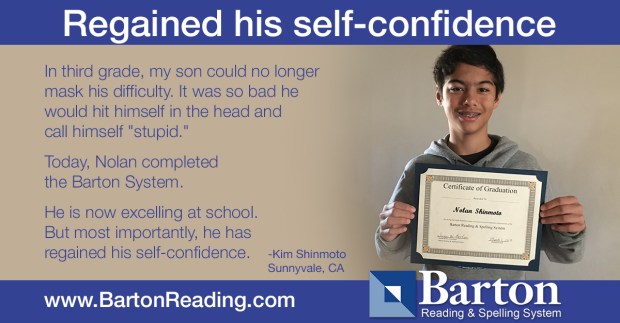
Regained his self-confidence
I love getting emails like this:
Five years ago, my son was struggling terribly. He was in third grade and could no longer mask the difficulty he was having with reading fluency.
Homework drove him to tears. It had gotten so bad that he would hit himself in the head and call himself “stupid.” It broke my heart.
Today, Nolan completed the Barton Reading & Spelling System with Janis Garcia, a wonderful Certified Barton Tutor. He proudly received his certificate signed by Susan Barton.
Nolan is excelling in school, but perhaps more importantly, he has regained his self-confidence.
I can’t thank you enough for all you have done to drive awareness, to advocate, and to provide resources for addressing the needs of children with dyslexia. It has made all the difference in the world for our family.
Kim Shinmoto, parent
Sunnyvale, CA
Never in 30 years
I would like share how very impressed I am with the Barton System.
As a Special Education teacher with more than three decades of teaching experience, I have used many different reading programs over the years. But I have never before encountered anything as comprehensive as your system. Thank you for all the time and effort you put into developing a true quality product.

The difference it is making for my dyslexic students is really impressive. Their reading and spelling skills, plus general self-esteem, grow visibly with each tutoring session.
I love using your program!
Anne Parker
The Open Door Educational Services
Ottawa, Canada
Light at the end of the tunnel
When you are going through the long process of tutoring, it can be hard to see the light at the end of the tunnel. So I wanted to share this message that was posted on a Facebook page for parents of children with dyslexia. This parent gave me permission to share her post.
A message of hope for all struggling students and parents:
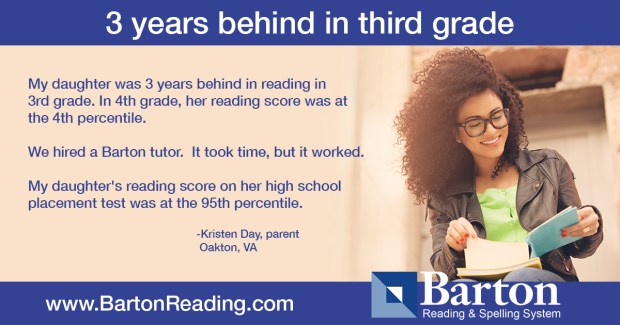
My daughter was 3 years behind in reading in 3rd grade.
At the beginning of 4th grade, testing showed she was only reading at the 4th percentile.
So we found a tutor, and over the next 3 years, my daughter went through the Barton Reading & Spelling System at her pace, and she learned to read.
The Barton System claims to be able to bring dyslexic children up to a 9th-grade reading level, and boy, did it deliver.
I just received my daughters results from the high school placement test where she scored … drum roll please … 95th percentile. That means she scored higher than 95 percent her peers.
She has gone from hating to read to reading a book a week. It has been quite an amazing transformation.
Thank you Susan Barton, my wonderful Barton tutor, and my amazing hard-working daughter who never gives up. Tears of joy flow freely.
Kristen Day, parent
Oakton, VA
After 45 years of feeling worthless
This is why adults are my favorite type of student:
Howard will be graduating from Level 10 of the Barton System in a few weeks.
Howard is an adult who was referred to us from a literacy center because they were not able to help him.
When Howard was young and in school, he was teased mercilessly because he could not read. He defended himself the only way he knew how — with his fists. The schoolyard scuffles turned into street fights, knife fights, and jail time.
When he came to us, he could not read the word “cat.”
He did not pass your student screening, so I had to start him with LiPS program and then took him into Level 1. He made slow but steady progress, although he considered dropping out because he felt the early words were too babyish. Luckily, he stuck with it, and he continued to improve.
Once, when we were walking out, I said to him, “You’re getting a little better each day.” He replied, “And I’m holding my head a little higher each day.” After 45 years of feeling worthless, he finally started feeling good about himself.
I wish I could say this story has a happy ending. Sadly, last April, Howard was diagnosed with ALS and the doctors only gave him 1-2 years. It’s been hard watching this once big, strong man deteriorate so much. He’s lost most of the control of his muscles, but his mind still works. We’ve been working very hard to finish the Barton System before the inevitable occurs.
I’m happy to say Howard will complete the entire Barton program in a few weeks. This is important because Howard has never achieved any scholastic success of any kind in his life. Your graduation certificate will be his first diploma of any kind.
Of the hundreds of students I’ve seen at the Dyslexia Reading Connection, none have made me more proud than Howard. He’s worked his tail off despite ever increasing obstacles, he’s never complained, and he’s always worked hard. I’m so happy to see him finally succeed in an academic pursuit.
Peter Ducklow
Dyslexia Reading Connection
Appleton, WI

His improvement has been so swift
It is amazing how quickly students improve once they get the right type of tutoring, as this parent shared:
As a toddler, Zach had delayed speech and trouble learning letters and words at a pace similar to his peers. After being screened by his public school in Kindergarten, he received reading intervention during his school day.
After school, he went through vision therapy and auditory therapy from first to third grade. At the end of those therapies, his eye doctor shared that Zach showed great improvements in all categories — except dyslexia.

At the time, we did not understand dyslexia and assumed Zach simply had difficulty transposing letters and numbers. Yet the school’s continuing reading intervention did not close the gap.
As a result, in fourth grade, Zach hit a wall and behavior issues emerged including frustration, anger — and avoidance of anything related to school or structured learning.
So we homeschooled Zach during fifth grade, but it did not help. He had the same behavior issues and the same academic challenges.
At our wit’s end, we finally got an IEE last October, which diagnosed Zach with dyslexia.
So Zach started working with Brook Euler, a local Certified Barton Tutor. Zach has almost finished Level 6, and he is now having great success in anything school related.
He started sixth grade in public school this past August. This first marking period, he received straight A’s and shows all the signs of having potential for great success in his future endeavors.
We don’t understand the Barton Reading & Spelling System, but it has been the key to unlocking Zach’s ability to accurately read and spell written words, and therefore, to comprehend what he reads.
For Zach, his improvement has been amazingly swift. He is now able to realize his full potential, and most importantly, he knows it.
Bob and Susan Kline, parents
Camp Hill, PA
From retained in third grade to Duke TIP
Once dyslexia is identified, and a child gets the right type of help, they can finally reach their potential — as this parent shared:
Susan, I had to share my daughter’s story with you and tell you how much of a life saver you and your programs are.
Prior to starting Kindergarten, we had no idea that McKenna had any issues. She seemed so bright, well-spoken and when I’d read to her at night, she’d take the book and read it back to me, or so I thought.
Once school started, however, it was a different story. I was contacted by her Kindergarten teacher telling me that she was sending McKenna for some extra testing and that she thought McKenna needed therapy for fine motor skills. The Guidance Counselor called me and told me that she didn’t even bother finishing the oral testing because McKenna was just too smart for it and didn’t even understand why McKenna had been sent for it. I figured McKenna was behind due to not going to preschool, being a lefty, and being younger than the other students.
But her struggles continued. We’d work on homework forever, she could never remember her spelling words even though we were constantly showing her flash cards, and forget about the concept of “sounding out words.”
We hired a school teacher as a tutor, and McKenna stayed after school several days a week.
In second grade, McKenna came home and announced that she had enrolled herself in extended day reading classes, and that I’d need to drop her off early twice a week for extra reading help. Despite all that, we’d still work until 9:00 pm on homework. Yet she’d only bring home C’s and D’s — after all that extra work.
I requested a parent teacher conference after EVERY report card, trying to figure out what was going on. All I was told was that I needed to make her read more, read more, read more. I cried after every single report card. They didn’t understand my concern since she was not failing, and she seemed to always “pull it up” by the end of the school year. They had NO idea how hard she was working, just to “pull it up.”
She was doing well in math until she got to third grade when it all became word problems with gigantic words like parallelogram.
In third grade, we added extra days with the tutor to prepare for the dreaded state testing. Based on that one test, they determine if a child is retained or promoted. McKenna was so terrified and had horrible anxiety. The night before the test, this third grader asked me if this test was going to affect her college applications. Then came the dreaded news that she did not pass.
When I gave her the results at home, she immediately ran to her room and locked the door. All I could do from the other side was tell this poor crying child that she was wrong to say that she “is stupid.”
She hated reading, so when she came home telling me about a book that she liked (James and The Giant Peach) I ran right to the book store to buy her a copy. She decided that since she had to attend summer school due to failing the test, that this was the book she was going to read. When she came home from summer school and threw the book away, I was confused. She told me that when the teacher walked by and saw her reading it, the teacher loudly announced, “You know you can’t read that book, so why are you pretending?”
I couldn’t take anymore and decided to research on my own instead of trusting the teachers. I also started discussing things with her pediatrician, which got the ball rolling with some of the testing. After months of testing, we were told she had ADHD with a visual processing disorder. Not really understanding what that meant, I took her to an eye specialist. Everything was normal, of course.
It wasn’t until I found your website and watched your videos and read all the parent accounts that I understood. I was blown away!!! I felt like the stories were being told by me.
I decided to have McKenna tested for dyslexia and reached out to you for testing centers. We found someone to perform the test, and I prepared myself and McKenna as much as possible for the outcome. I was so worried that I was wrong about her having dyslexia and would have to start over. Yet she fit all the descriptions so perfectly, and it felt amazing to be able to put a name on this problem that I’d been trying for years to describe to all her teachers.
I even asked McKenna if she’d be upset if she was diagnosed as dyslexic. Her answer broke my heart. She told me that she would be upset if she did NOT have dyslexia because that would mean she was just stupid.
Her diagnosis came back as dyslexia. We had an answer. Now we needed a plan. Back to your website I headed.
I ordered the first part of the Barton Reading System while also beginning to work with the school on getting interventions into place. That took almost an entire school year, and they did not offer any sort of remedial help that would actually help with teaching a dyslexic how to read. I was so frustrated, but I knew what to expect from my research.
I simply let every teacher know that some of her regular homework would NOT be done because I was substituting that time to tutor McKenna with the Barton Reading System.
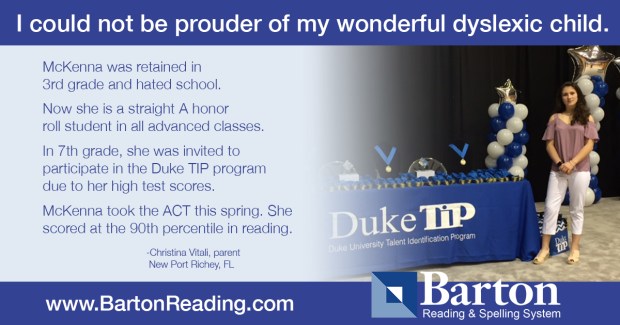
Fast forward a couple of years. McKenna has gone from being retained in 3rd grade and hating school, to straight A honor roll in all advanced classes.
And in her 7th grade year, she received an invitation to participate in the Duke University TIP program (Talent Indentification Program) due to some of her high test scores.
McKenna took the ACT in February and got amazing test results. Not only was she awarded by Duke at the state level, but she received an invitation to go to Duke University to receive recognition on the national level.
The irony is that the portion of the ACT that she scored highest at the national level was the reading portion!!!!!! McKenna scored higher than 90% of high school students who took the test and she was only in 7th grade.
I couldn’t be prouder of my little dyslexic wonder kid. She has embraced her dyslexia and is her own greatest advocate at school. I let her direct her IEP meetings for the most part and only offer help when I need clarification.
I cannot thank you enough. I heard your story about your nephew and loved your determination to help him. I can tell you that I understand the desperation you must have felt. I was so lost and desperate until I found BrightSolutions.US. Once I began researching on that site, I couldn’t stop talking to people about it.
I used to cry and tell my husband that school and homework was destroying my relationship with my daughter. I just knew that she hated me because I kept pushing. I simply did not understand what was wrong. I was the mom who told her she wasn’t trying hard enough and that she needed to read more — because that’s what the teachers were telling me.
You’ve helped me help my daughter, and that is such a precious gift. She absolutely knows now that she isn’t “stupid.”
Thank you from the bottom of my heart.
Christina Vitali, parent
New Port Richey, FL
Nate never failed
Parents often discover dyslexia late in their first child. But they catch it earlier in their next child, and early intervention makes such a difference — as this parent shares:
Nate is one of those rare dyslexics who has never had to “prove” his dyslexia through failure. While his older sister was going through the evaluation process, and I was busy reading everything I could get my hands on about dyslexia, I realized my younger son, Nate, had many of the early warning signs you discuss in your videos.
So when I started tutoring my daughter using the Barton System (in the spring of her second grade year), I also started tutoring Nate, who was 5 1/2 at the time and not yet in kindergarten.
Because of your program, from the time he entered elementary school, Nate has always read above grade level.
He has never had to be pulled out from class to go to a “special reading group,” he does not require accommodations, and his teachers consistently remark on his self-confidence and leadership qualities within the classroom setting.
When I meet with our school principal and other teachers to discuss dyslexia, I am proud to be able to point to both of my children as examples of what appropriate intervention can achieve.
I can’t tell you how much I appreciate being able to learn how to tutor my own kids, on our own schedule, for a fraction of the cost of private tutoring for two children.
I am proud that I taught my children to read, and I continue to use the skills I learned when we read together.
Theresa Sorensen
Happy Valley, OR

Early Intervention Works
This parent got Barton tutoring for her son in kindergarten — and it quickly healed his emotional scars.
Susan, I heard you speak about dyslexia in Appleton when my son was 5.
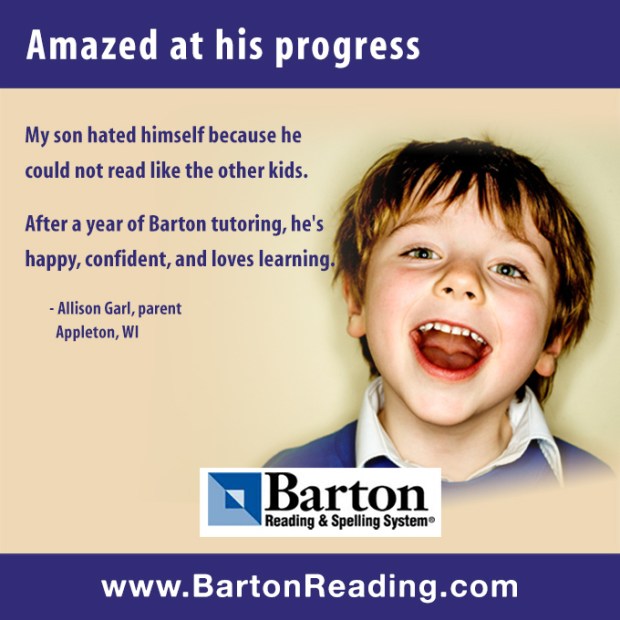
At the beginning of kindergarten, he was already saying that he hated himself because he was stupid — because he couldn’t read like the other kids. I was shocked to hear him say it with such strong emotion at that young age.
He’s now had a year of Barton tutoring at the Dyslexia Reading Connection Center.
If only if you could have been a fly on the wall at his last parent-teacher conference. He’s starting to read and is proud of what he’s accomplishing. He’s happy, confident, and a leader in his Montessori classroom.
And best of all, he WANTS to learn. That spark was not extinguished.
We are amazed and so deeply grateful for his progress.
Things are going really well, and I believe he’s going to continue having the school experience every child so deserves — where they feel safe and accepted, even if they learn differently.
And I’m so grateful to you for dedicating your life to dyslexia awareness and education.
Alison Garl
Appleton, WI
Soar with success
I love it when schools spend a year doing a pilot program using the Barton System – because I know the results will be great. And next year, the school will expand the program, as this teacher shared:
Susan, with your help and guidance through our first year using the Barton Reading & Spelling System, we have had students soar with growth.
We have seen discouraged, defeated parents turn into encouraged and hopeful parents. Students beam when they feel and see how much they have accomplished over the year.
For instance, a 4th grader started the year reading at a 2.9 grade level. After seven months of doing the Barton System, she is now reading at a 5.1 grade level.
We want to thank you so much. We will be forever grateful to you and your program.
And it’s only the beginning!
Valena Taber, Education Coordinator
South Columbia Family School
Warren, OR


 Bright Solutions for Dyslexia